Social Enterprise Typology
Social Enterprise TypologyAbout this Typology
About this TypologyThis typology breaks down the traditional boundaries between the nonprofit and private sectors and draws definition to this new institutional animal--part business-part social--the social enterprise. In doing so, the typology explores how institutions have combined a mix of social values and goals with commercial business practices and how they have come up with ownership models, income and capitalization strategies, and unique management and service systems designed to maximize social value. The illustrative typology classifies different models of social enterprise in order to navigate readers through the currently ill-defined, diverse and dynamic landscape of this emerging field.
This typology is an outgrowth of a paper commissioned by the Inter-American Development Bank in 2003 entitled: "Social Enterprise: A Typology of the Field Contextualized in Latin America." For this reason many of the examples are from Latin America, however, social enterprise models are applicable worldwide.
The typology is a work in progress, and will be updated with new models, examples, and case studies. We invite you to send us your comments and examples of your social enterprises that we can include here.
This work is licensed under the Creative Commons Attribution-Share Alike 3.0 Unported License. Attribution should be made by providing a link to https://www.4lenses.org/setypology.
The Author
The AuthorKim Alter has endeavored to bring business practices to nonprofit organizations and international development agencies, encouraging their sustainability through earned income, in more than 30 countries worldwide for over a dozen years.
She is founder and Principal of Virtue Ventures, a management consulting firm specializing in social enterprise.
Kim is author of Managing the Double Bottom Line: A Business Planning Guide for Social Enterprises (Pact Publishers 2000) and contributing author of Generating and Sustaining Nonprofit Income (Jossey-Bass 2004).
Web and document designs are by Vincent Dawans from Virtue Ventures.
Kim and Vincent can be contacted via the online contact form .
Document Structure
Document StructureThe typology is organized in five main sections that can be read in any order based on the reader's interest and familiarity with the subject.
The first section introduces the subject with various definitions of social enterprise, a history in brief, an overview of the field's current state and outlook as well as a discussion on the evolution of the field toward an integrated approach.
The second section puts the social enterprise field in context. It starts by organizing practitioners on a spectrum by their philanthropic versus their commercial orientation. It then examines notion of “hybrid” or “dual purpose” entity, which creates both economic and social value, as well as the implications of a hybrid approach on an organization's financial strategy and program strategy.
The third section presents several ways of classifying social enterprises, either based on their mission orientation, based on the level of integration between social programs and business activities, or based on the nature of their target market.
The fourth section presents several common social enterprise operational models grouped into three main structural categories which cover a wide range of interplay between several variables, such as clients, market, social service programs, mission orientation, financial objectives, etc.
Finally, the fifth section examines social enterprise structures as they relate to ownership and legal status.
Acknowledgements
AcknowledgementsThe Inter-American Development Bank must be recognized for commissioning the original version of this paper entitled: “Social Enterprise: A Typology of the Field Contextualized in Latin America,” (September 2003) to commemorate the 25 years of innovation through their Small Projects Fund and Social Entrepreneurship Program (SEP). Without the support provided by the Inter-American Development Bank this work simply would not have been possible.
Specific thanks are owed to Alvaro Rameriz, Division Deputy Chief and Jacqueline Bass, Senior Advisor for Micro and Small Enterprise, the Inter-American Development Bank, who provided the foresight and leadership to instigate this typology, labored over the cases, and tirelessly read and commented on the paper in its various incarnations.
I would like to thank and acknowledge the contributions of the following individuals who agreed to review and provide feedback on this paper. Each one is a respected leader and major contributor to the social enterprise and international economic development fields; their thoughts, ideas, words, and previous work laid the foundation for this piece.
- Shari Berenbach, Executive Director, Calvert Foundation
- Lee Davis, Co-Founder and CEO, NESsT
- Nicole Etchart, Co-Founder and CEO, NESsT
- Jed Emerson, Senior Fellow William and Flora Hewlett Foundation, David and Lucile Packard Foundation and Lecturer Graduate School of Business Stanford University
- Cynthia Gair, Portfolio Director, The Roberts Enterprise Development Fund
- Didier Thys, Executive Director, Microfinance Information Exchange
Additional thanks are owed Lee Davis and Nicole Etchart for sharing cases from the NESsT portfolio, and to Jed Emerson, who kindly agreed to write the foreword. Special recognition goes to Vincent Dawans from Virtue Ventures for his contributions to sections on impact measurements and graphical representations. Finally, much gratitude is due to Laura Brown, faithful editor, who willingly took this paper in its original incarnation on her vacation.
About the Inter-American Development Bank’s Social Entrepreneurship Program (SEP)
About the Inter-American Development Bank’s Social Entrepreneurship Program (SEP)The Inter-American Development Bank began supporting income generating nonprofit organizations and cooperatives in 1978 through its Small Projects Fund long before there was a field dubbed social enterprises. In 1998, the Social Entrepreneurship Program (SEP), which replaced the Small Projects Fund, was created to promote social equity and the economic development of poor and marginal groups. The Social Entrepreneurship Program promotes business operations that generate social benefits and help community organizations encourage microenterprise development. Thus, in its 25-year history, the Bank has supported numerous projects that fall under the rubric of social enterprise through this program.
The SEP grants low interest loans of up to US$1 million; in addition, it offers technical assistance grants of up to US$250,000, which are allocated to the development and strengthening of innovative institutions. SEP uses its resources strategically and funds a limited number of representative projects; such operations must be capable of promoting learning between countries or of being emulated in other parts of the region.
IBD Social Entrepreneurship Program (SEP) Support to Social Enterprise
- Invests US$10 million annually to develop and strengthen innovative institutions.
- Provides low interest loans of up to US$1 million and grants of up to US$250,000 for technical cooperation.
- Supports financial services and business development projects with a special emphasis on poor and marginalized groups.
- Provides average long-term loans of US$500,000.
SEP is a highly competitive program, providing US$10 million annually to finance projects in 26 Latin American and Caribbean countries. Government agencies, bilateral funds, and multilateral donors have joined forces with IDB and the Social Entrepreneurship Program to strengthen that assistance. Several trust funds, such as the European Union Special Fund for the Financing of Small Projects in Latin America, the European Union Special Fund for Financing Microenterprise in Latin America, the Swedish Trust Fund for the Financing of Small projects, the Norwegian Fund for Small Projects, the Norwegian Fund for Microenterprise Development, the Japan Special Fund, the Swiss Technical Cooperation and Small Project Fund, and more recently the Italian Trust Fund have contributed, channeling support to rural and minority groups, and providing technical assistance to strengthen nonprofit organizations. The IDB Group is committed to contributing to the success of this new type of social enterprise and supporting projects that offer financial and business development services as well as social and community services in a sound, efficient, and sustainable way to benefit low-income people, indigenous groups, women, youth, and other marginalized groups.
Foreword to the original version, by Jed Emerson
Foreword to the original version, by Jed EmersonThe ability to create, to break the mold, to engage in enterprise is perhaps one of the greatest attributes of humanity.
Our capacity for shortsightedness, bias, and provincialism is perhaps our greatest weakness.
This document gives evidence of the first, and foreshadows the coming of the second.
While its roots are deep in our past, over the last three decades we have witnessed an explosion of innovation as a growing international community of individuals has experimented with a great variety of approaches to fulfilling one basic idea:
Markets and business, capital and commerce can be harnessed not simply for the creation of individual wealth, but rather the creation of value in its fullest.
These innovators have sought to create value consisting of equal parts equity, ecology, and economic development. They have broken with the beliefs of traditionalists to practice a form of social enterprise that seeks to engage in the community application of business skill and acumen. These social entrepreneurs have created a rich diversity of approaches and strategies, all of which are now coming together within a unified, global parade.
It is, however, a parade of many marchers, bands, and different colored banners. Having spent years on various side streets, the diverse parts of the parade are now flooding the grand avenue and approaching the town square, which is filled by glorious music and pageantry--and yet in the midst of the celebration we are suddenly aware we have a problem.
Too much creativity? Never!!
But too many words clashing in meaning; too many ideas promoted before having stood the test of time; and too many parts moving in a blur of confusion.
What is needed is a way to rise above the fracas, a tool to help us transcend the music of our own band in order to see the breadth of the musical parade in motion before us. What we need is a single, clear assessment of who "we" are and "what it is we are doing."
Kim Alter has presented us with such a tool.
Building on the nearly three decades of funding experience of the Social Enterprise Program of the Inter-American Development Bank, drawing upon the writings of practitioners and thought leaders from around the world, Kim has done an excellent job presenting us--social entrepreneur, investor, academic, and practitioner--with a set of frameworks and definitions to assist each of us in understanding how our own work fits with that of others and how together these various parts are unavoidably becoming interwoven into a singular whole.
By presenting us with a host of social enterprise models, this typology lets us see how our own approach to enterprise can be consistently defined and compared with that of others. By focusing upon the Bank's portfolio of investments in Latin and South America for examples, Kim has reminded us that the drive to enterprise is not a U.S., European or First World phenomenon, but rather one that speaks to the essence of human experience and ambition regardless of border, language, or level of literacy.
And by approaching her analysis from the perspective of a reflective practitioner, she tells us yet again that each of us can and must learn from each other. The best lessons and experiences are in the streets, the barrios, and the rural hillsides as theory meets practice and intense labor comes to be informed by thought. This document gathers the work of the whole and infuses it with thought in order for others to learn and understand more deeply the significance of the international efforts currently in motion.
Of course, the "problem" with assisting us in achieving greater understanding of the connections between our various labors is that we can no longer pretend that what we are engaged in is an "experiment" or a "demonstration project" or "proof of concept." Many questions remain and must be answered, but the notion that social entrepreneurship is a fad or thin intellectual fancy of those who couldn't make it in mainstream business is proved wrong not only by the work presented in the following pages, but by the continuing personal witness of literally tens of hundreds of social entrepreneurs the world over who now, via the Internet and the gathering storm of intellectual awareness, are proving themselves worthy of not grants, but investments; of not initiatives, but permanent program areas of major foundations and governmental funding bodies.
The "problem" with documenting an area of work so well is that we are now faced with at least two questions. First, now that the demonstration grants have demonstrated that fad is now trend and inquiry both emerging knowledge and expertise, we must ask:
Where is the serious money?
Where are the international field-building initiatives? Where is the "second tranche" of investment to take these ideas and organizations to real, meaningful scale and, thus, broader social and environmental impact? The challenge to the funding community, both private and public, is stark:
Are you in or are you out?
The practitioners have demonstrated both skill and informed practice. Now the funding community must follow through with strategic and significant amounts of capital (market-rate, concessionary, and philanthropic) to assure these efforts fulfill their obvious potential. In the words of one of my foundation colleagues, "It is time we move from our practice of 'let a thousand flowers wither' to let the best flowers bloom."
This document, and the many organizations whose work it draws upon, demonstrates the reality that the willing stand ready and waiting. Let us pray they do not stand waiting as long as it may take this report to begin gathering dust upon the shelf…
But the evidence presented in this document raises another question, and this one is directed at the practitioners of social enterprise. The second question is, quite simply:
What is it that you are really trying to do?
Over the past years, we have, each of us, contributed to a cacophony of concepts, terms, and ideas. We are all quite impressed with our disparate visions and intellectual approaches. And, yes, we are all quite cute and brilliant and revolutionary in our work. To be quite frank, there is a part of us (dare I say a large part?) that likes to be different and enjoys engaging our colleagues in nauseatingly long discussions of the social enterprise equivalent of how many angels can dance on the head of a pin.
We might pause for a moment and think:
If all we are trying to do is prove we can be communists in capitalists' clothing, fine. This paper demonstrates that we have proved our point. Those who were waiting for the definitive proof may now go home…
But, what if what we are really trying to do is change the world and what is really driving us to rise up early in the morning and fall into our dreams late at night is the vision of a genuinely transformed planet? If that is the case, then we need to see how our diversity consists only of divisions if one is face to face, nose to nose, and cheek to jowl with the notion of social enterprise--but as we step back a bit, as we take time to ponder what we really want to see around us in 30 years time, something else becomes quite clear:
The work of social entrepreneurship and the creation of social enterprise is also the work of a for-profit manager striving to drive the practice of corporate social responsibility into her firm; and, in truth, the approach of a venture philanthropist is not six degrees removed from that of a socially responsible investor or manager of a community loan fund.
What becomes clear is that it is all the same and we are all part of a common effort to create more effective tools to maximize total value for our entire global community.
The particular worth of the document presently in your hands is in some ways its simple contribution to helping us all see the parts that we are…
But the true potential of this document, for practitioners and investors alike, is the fact that it points toward the inherent truth that all of us are engaged in giving birth to ideas and skills that hold the promise of creating meaningful, full, and integrated value for investors, managers, entrepreneurs, and the future children of our world.
We must understand that defining the parts is just the first step toward embracing the whole. With this contribution by Kim Alter and the Inter-American Development Bank now in place, we must think long and hard about how we can best bring these parts together into a focused drive toward the real, ultimate goal:
the creation of sustainable economies, ecology, and equity that will be of benefit to all beings within communities and regions around the world.
Do we have what it takes to build our global communities at the same time we labor to expand our own organizations and pursue our individual strategies?
We could do a lot worse than try…
Celebrate the Struggle!
Jed Emerson1
Grand Lake, CO
- 1Jed Emerson is Senior Fellow William and Flora Hewlett Foundation, David and Lucile Packard Foundation and Lecturer Graduate School of Business Stanford University
Bibliography
Bibliography- Alter, Sutia Kim, Case Studies in Social Enterprise: Counterpart International's Experience, Counterpart International, Washington DC, 2002
- Alter, Sutia Kim, et al, Generating and Sustaining Nonprofit Income, forthcoming from Jossy-Bass, Spring 2004.
- Alter, Sutia Kim, Managing the Double Bottom Line: A Business Planning Resource Guide for Social Enterprises, Pact Publications, Washington, DC, 2001.
- Berenbach, Shari, From SRI to Community Investment, Calvert Foundation, 2002.
- Bochee, Jerr and Jim McClurg, Toward a Better Understand of Social Entrepreneurship: Some Important Distinctions, Social Enterprise Alliance, 2003.
- Bochee, Jerr, The Social Enterprise Sourcebook, Northland Institute, Minneapolis, Minnesota, 2001.
- Bochee, Jerr, Merging Mission and Money: A Board Member's Guide to Social Entrepreneurship, National Center for NGO Boards, Washington, DC, 1998.
- Business for Social Responsibility.
- Community Wealth Ventures, Venture Philanthropy 2001: Changing Landscape, Morino Institute, 2001.
- Community Wealth Ventures, Unlocking Profit Potential: Your Organization's Guide to Social Entrepreneurship, BoardSource, Washington, DC, 2002.
- Dees, Greg, The Meaning of Social Entrepreneurship, The Kaufmann Center for Entrepreneurial Leadership and Ewing Marion Kaufmann Foundation, 1998.
- Dees, Gregory, Enterprising Nonprofits, Harvard Business Review, January-February 1998.
- Dees, Gregory, Jed Emerson, and Peter Economy, Enterprising Nonprofits: A ToolKit for Social Entrepreneurs, John Wiley and Sons, 2001.
- Dulany, Peggy and David Winder, The Status of and Trends in Private Philanthropy in the Southern Hemisphere, The Synergos Institute, 2000-3.
- Emerson, Jed and Sheila Bonni, The Blended Value Map: Tracking the Intersects and Opportunities of Economic, Social and Environmental Value Creation, September, 2003
- Emerson, Jed, The Nature of Returns, A Social Capital Markets Inquiry into the Elements of Investments and The Blended Value Proposition, Harvard Business School, Boston, Mass., 2000.
- Emerson, Jed, and Fay Twersky, New Social Entrepreneurs: The Success, Challenge and Lessons of Nonprofit Enterprise Creation, San Francisco: Roberts Foundation, 1996.
- Etchart, Nicole and Lee Davis, Unique and Universal: Lessons from the Emerging Field of Social Enterprise in the Emerging Market Countries, NESsT, 2003.
- Etchart, Nicole and Lee Davis, NESsT Case Series, Corporacion CIEM Aconcagua: Furthering Organizational Mission Through Self-Financing, NESsT, May 2001.
- Etchart, Nicole and Lee Davis, Profits for Nonprofits, NESsT, 1999.
- Etchart, Nicole and Lee Davis, The NGO Venture Forum, NESsT, 1999.
- Fremont-Smith, Marion, A 'How to' for Joint Ventures, Hauser Center for NGO Organizations, Harvard University, 2002.
- Harvard Business Review on NGOs, Harvard Business School Press: Cambridge, Mass., 1999.
- IADB, America Latina frente a la desigualdad: Informe de progreso economico y social en America Latina, 1999.
- Kramer, Mark, Venture Capital and Philanthropy, The Chronicle of Philanthropy, April 22, 1999.
- Letts, Ryan, and Grossman, Virtuous Capital: What Foundations Can Learn from Venture Philanthropists, Harvard Business Review, 1996.
- Nuria Cunill Grau, Repensando lo publico a traves de la sociedad. Nuevas Formas de gestion publica y representation social, CLAD-Nueva Sociedad, 1997.
- Reis, Tom, Unleashing New Resources and Entrepreneurship for the Common Good: A Scan, Synthesis, and Scenario for Action, W.K. Kellogg Foundation, January 1999.
- The Roberts Enterprise Development Fund, Investor Perspectives: Social Purpose Enterprise and Venture Philanthropy in the New Millennium, The Roberts Foundation, San Francisco, 1999.
- Social Enterprise Alliance.
- Sealey, Kevin, Wendy Sealey, Jerr Boschee and Jed Emerson, A Reader in Social Enterprise, 2000.
- Spinali, Lisa and Hayley Mortimer, A Scan of the Not-For-Profit Entrepreneurship: Status of the Field and Recommendations for Action, Kauffman Center of Entrepreneurial Leadership, January 2001.
- Young, Dennis, Social Enterprise in the United States, 2001.
Introduction
IntroductionThe purpose of this typology is to elaborate the rich mosaic of highly differentiated and creative examples of social enterprise, and by doing so, to inspire innovative approaches to create greater value for people and the planet. The typology is also intended to advance the field of social enterprise by organizing these diverse approaches and strategies into a common framework. The occupation of identifying and defining operational models as well as organizational and legal structures is to provide a conceptual framework for efforts occurring in the field.
A basic premise used in this typology is that of a spectrum, which avoids bifurcating the landscape into opposing functions: one, the for-profit world whose raison d'être is to create economic value; and the other, the nonprofit world whose purpose is to create social value. In practice, these dichotomies are increasingly coming together through the application of methods that marry market mechanisms to affect both social and economic value resulting in total value creation. The emergence and the subsequent propagation of corporate social responsibility, business for social responsibility and social enterprise evidences this trend, and the social enterprise lens brings into focus this convergence through its methodological paradigm.
Value creation is the backbone of social enterprise and serves as a fundamental and unifying principle between different social change and economic development approaches. To this end, the typology is not intended to straightjacket practitioners into a prescribed set of formulas, but rather recognize and embrace the abundance of possibility under the umbrella of a larger vision.
Definitions of Social Enterprise
Definitions of Social EnterpriseAs early as 1996 The Roberts Foundation Homeless Economic Development Fund1 defined social enterprise as "a revenue generating venture founded to create economic opportunities for very low income individuals, while simultaneously operating with reference to the financial bottom-line."2
NESsT, on the other hand, uses the term social enterprise to refer to "the myriad of entrepreneurial or 'self-financing' methods used by nonprofit organizations to generate some of their own income in support of their mission."3
Both definitions capture the social and financial characteristics of the social enterprise; however, The Roberts Foundation's definition emphasizes social enterprise as a program approach, whereas NESsT's definition stresses it as a funding approach.
The Nonprofit Good Practice Guide offers a holistic definition: "A nonprofit venture that combines the passion of a social mission with the discipline, innovation and determination commonly associated with for-profit businesses [...]"
The UK-based Social Enterprise Coalition reminds us that the simplest definition of social enterprise - as business trading for a social purpose - allows for a wide range of interpretations and there is still an ongoing debate among practitioners and academics over the exact definition of social enterprise.
The Coalition invites us to consider some of the common characteristics that social enterprises display:4
- Enterprise Orientation - they are directly involved in producing goods or providing services to a market.
- Social Aims - they have explicit social and/or environmental aims such as job creation, training or the provision of local services. Their ethical values may include a commitment to building skills in local communities. Their profits are principally reinvested to achieve their social objectives.
- Social Ownership - Many social enterprises are also characterised by their social ownership. They are autonomous organisations whose governance and ownership structures are normally based on participation by stakeholder groups (eg employees, users, clients, local community groups and social investors) or by trustees or directors who control the enterprise on behalf of a wider group of stakeholders. They are accountable to their stakeholders and the wider community for their social, environmental and economic impact. Profits can be distributed as profit sharing to stakeholders or used for the benefit of the community.
The Coalition also supports the UK Government definition which many of its members were actively involved in helping to develop5 : "A social enterprise is a business with primarily social objectives whose surpluses are principally reinvested for that purpose in the business or in the community, rather than being driven by the need to maximise profit for shareholders and owners. [...]"
Virtue Ventures proposes the following working definition of social enterprise, inspired by these definitions and others, that captures the specificity of purpose and approach while encompassing the broad range of practical applications:
A social enterprise is any business venture created for a social purpose--mitigating/reducing a social problem or a market failure--and to generate social value while operating with the financial discipline, innovation and determination of a private sector business.
In its widespread usage, "social entrepreneur" is the individual and "social enterprise" is the organization. Therefore, social enterprise is an institutional expression of the term social entrepreneur.
Additional information available on the World Wide Web:
- An Exploration of Contemporary Meanings of Social Enterprise, by Leo Bartlett, Australasian Institute for Social Entrepreneurship;
- A glossary of useful terms (PDF), from the Institute of Social Entrepreneurs;
- Toward a better understanding of social entrepreneurship: Some important distinctions (PDF), by Jerr Boschee and Jim McClurg.
- The Blended Value Glossary (PDF), by Elizabeth Bibb, Michelle Fishberg, Jacob Harold, and Erin Layburn
- 1The name was changed from The Roberts Foundation Homeless Economic Development Fund (HEDF) to The Roberts Enterprise Development Fund (REDF) in 1997.
- 2Jed Emerson and Fay Twersky, New Social Entrepreneurs: The Success, Challenge and Lessons of Nonprofit Enterprise Creation, The Roberts Foundation Homeless Economic Development Fund, 1996.
- 3Definition provided by NESsT (www.nesst.org); in 1997 NESsT began referring to self-financing--what today is referred to as social enterprise.
- 4Social Enterprise Definitions, Social Enterprise Coalition website
- 5Social Enterprise - a strategy for success DTI, 2004
History in Brief
History in BriefSocial enterprise has a lengthy private history, but a short public one. Nonprofit organizations have long engaged in income generation and businesses to either supplement or complement their mission activities. 1
In the United Kingdom, cooperatives functioned as a means to fund socioeconomic agendas as early as the mid-1800s. Beginning in the 1960s, US nonprofits experimented with enterprises to create jobs for disadvantaged populations. Micro-credit organizations made their appearance in developing countries by the 1970s, at about the same time Community Development Corporations (CDCs) were gaining popularity in the United States. Yet it is only in the last 15 or 20 years that academics, practitioners, and donors have been studying and recording cases of nonprofits adopting market-based approaches to achieve their missions.
The growing practice of social enterprise is fueled by nonprofit organizations’ quest for sustainability, particularly in current times when support from traditional, philanthropic, and government sources is declining and competition for available funds is increasing. Social enterprise enables nonprofits to expand vital services to their constituents while moving the organization toward self-sufficiency. Nonprofit organization leaders understand that only by establishing an independent means of financing can they become a going concern.
The Pioneers
John Durand began working with seven mentally retarded people in 1964, today Minnesota Diversified Industries is a for-profit social enterprise which employs over 500 disabled people. In 2000 the company reported $54 million dollars in annual revenues with only half a million coming from grants.
In 1971 with a $1,000 loan from a moneylender, Mimi Silbert began a program for recovering drug addicts and ex-convicts. Since its inception Delancey Street has successfully mainstreamed over 15,000 former clients on self-generated resources from its numerous businesses: restaurant, moving company and construction, which cumulatively net revenues of over $6 million a year (2001).
In 1963, Jack Dalton opened Pioneer Fellowship House as a residence for recovering alcoholics, he required each resident to pay $25 per week for room and board, perform house chores and attend nightly meetings.2 Today, through its employment, training, and behavioral health and community corrections programs, Pioneer Human Services (PHS) serves over 5,000 clients a year, 1,300 at any given time. PHS employs a staff of approximately 900, and has an annual budget of roughly $55 million, 99.6 percent of which is earned through sales of its products and services from its eight businesses which run the gamut from manufacturing, food service, distribution and logistics, real estate asset management, and printing.
Professor Muhammad Yunus, Head of the Rural Economics Program at the University of Chittagong, Bangladesh, began a research project in 1976 to explore the possibility of providing banking services to the rural poor. The Grameen Bank Project (Grameen means "village" in Bangla language) was piloted in three villages neighboring the University with the following objectives: to extend banking facilities to poor men and women; to eliminate the exploitation of the poor by money lenders; to create opportunities for self-employment for the multitude of unemployed people in rural Bangladesh; and to enable disadvantaged (mostly women from the poorest households) to self-manage money and business. Based on its success, the project expanded in 1979 to several locations throughout Bangadesh including Dhaka, the capital. By October 1983, the Grameen Bank Project was transformed into an independent bank by government legislation.
Today Grameen Bank serves over 2.4 million borrowers and has over 20 businesses including:
- Grameen Shakti (GS), a not-for-profit rural power company whose purpose is to supply renewable energy to unelectrified villages in Bangladesh as well as create employment and income-generation opportunities in rural Bangladesh;
- Grameen Telecom whose objective is to provide mobile phone service to 100 million inhabitants in rural Bangladesh by financing members of Grameen Bank to provide village pay phone service and by providing direct phones to potential subscribers;
- Grameen Knitwear Limited, a 100% export-oriented composite knitwear factory.
The Players and Practice: The Making of a Field
The Players and Practice: The Making of a FieldSince it is not possible to detail a comprehensive history of social entrepreneurship movement and all those that have made contributions to its evolution in this report, this section provides a brief historical overview of some key players and events that have contributed to shaping the field of social entrepreneurship.
Cooperatives
CooperativesPerhaps the roots of entrepreneurial activities in the social sector context can be drawn to cooperatives which have functioned as a means to fund socioeconomic agendas as early as the mid-1800s. Robert Owen (1771-1858) fathered the cooperative movement. A Welshman who made his fortune in the cotton trade, Owen believed in putting his workers in a good environment with access to education for themselves and their children. These ideas were put into effect successfully in the cotton mills of New Lanark, Scotland. It was here that the first cooperative store was opened. Spurred on by the success of this, he had the idea of forming "villages of cooperation" where workers would help themselves out of poverty by growing their own food, making their own clothes and ultimately becoming self-governing.1
Cooperative is defined by the International Cooperative Alliance (ICA) as "an autonomous association of persons united voluntarily to meet their common economic, social, and cultural needs and aspirations through a jointly-owned and democratically-controlled enterprise".2 They "are based on the values of self-help, self-responsibility, democracy, equality, equity and solidarity. In the tradition of their founders, cooperative members believe in the ethical values of honesty, openness, social responsibility and caring for others".3 Noticeably, the cooperative definition and characteristics are those embraced by social entrepreneurship.
Since their inception over one hundred years ago, cooperatives have become widespread throughout the world, and continue to play an important function in promoting international economic development and social justice for the poor. Cooperatives are a common form of social enterprise found in developing countries. Examples include agricultural marketing cooperatives, which market and distribute its members' products, while agricultural supply cooperatives, provide inputs into the agricultural process; both are examples of social enterprises promoted in value chain development and Making Markets Work for the Poor (M4M). Self-Help Groups (SHGs) comprised of low income-women, and popular in South Asia, are frequently organized into cooperatives to support a variety of their members' interests related to commerce, health and education. Credit Unions are another example of a cooperative found tied to economic development micro-financial service programs, particularly across West Africa, Latin America, and countries of the former Yugoslavia. In the UK a slight variation on the cooperative, called mutual organizations or "societies" are commonly associated with social enterprise. Unlike a true cooperative, mutual members usually do not contribute to the capital of the social enterprise company by direct investment, instead mutuals are frequently funded by philanthropic sources or the government.
- 1Wikipedia website https://en.wikipedia.org/wiki/Cooperatives
- 2Co-operative Alliance website (www.ica.coop/coop/principles.html)
- 3Ibid.
Fair Trade
Fair TradeFair Trade is another predecessor to the contemporary social entrepreneurship field. Early attempts to commercialize fair trade goods in Northern markets were initiated in the 1940s and 1950s by religious groups and various politically oriented NGOs. Mennonite Central Committee (MCC) and SERRV International were the first, in 1946 and 1949 respectively, to develop fair trade supply chains in developing countries.1 The products, almost exclusively handicrafts, were mostly sold in retail outlet called "Worldshops." MCC's historic Worldshop, Ten Thousand Villages, is well-known today and has numerous locations throughout the US. Ten Thousand Villages operates as nonprofit subsidiary social enterprise of MCC.
The current fair trade movement was shaped in Europe in the 1960s. Fair trade during that period was often seen as a political gesture against neo-imperialism: radical student movements began targeting multinational corporations and concerns that traditional business models were fundamentally flawed started to emerge. The slogan at the time, "Trade not Aid", gained international recognition in 1968 when it was adopted by the United Nations Conference on Trade and Development to put the emphasis on the establishment of fair trade relations with the developing world.2 Nineteen sixty-five saw the creation of the first Alternative Trading Organization (ATO) and that same year, British Oxfam launched "Helping-by-Selling", a program which sold imported handicrafts in Oxfam stores in the UK and from mail-order catalogues.3 Worldshops for fair trade goods spread to the Netherlands in 1969 and expanding throughout Europe in the 1970s. In the early 1980s, to offset a decline market for handicrafts, Alternative Trading Organizations began broadening the scope of fair trade from handicrafts to include agricultural products, particularly commodities, whose spiraling prices had a dire impact on poor producers.
In 1988 Fair Trade labeling initiative was launched to promote fair trade commodities and agricultural products, followed by International Fair Trade Certification Mark in 2002. There are now Fair Trade Certification Marks on dozens of different products, based on Fairtrade Labeling Organization's (FLO) certification for coffee, tea, rice, bananas, mangoes, cocoa, cotton, sugar, honey, fruit juices, nuts, fresh fruit, quinoa, spices, wince and footballs. In 2005 these sales amounted to approximately €1.1 billion worldwide, a 37 % year-to-year increase.4 As per October 2006, 586 producer organizations in 58 developing countries were FLO-CERT Fairtrade certified and over 150 were International Fair Trade Associations were registered.5
Community Development Corporations
Community Development CorporationsIn the United States, Community Development Corporations (CDCs) made their appearance catalyzing economic growth by investing in job creation, business development, real estate and affordable housing in target communities. Prior to the 1970s, banks "redlined" against minority neighborhoods, even to credit-worthy residents. In 1973, ShoreBank founders, Ron Grzywinski, Mary Houghton, James Fletcher, and Milton Davis, with backgrounds in banking, social service and community activism, decided to buy a bank in a disinvested neighborhood, and create complementary affiliates, focusing all of the resources on one neighborhood.1
Today, Shorebank has several branches around the US including its "Environment Bank" in the Pacific Northwest that invests in sustainable development as well it has opened a myriad of nonprofit subsidiaries that provide support technical and financial services to complement Shorkbank's private sector efforts. For example, Shorebank International Ltd., supports international economic development activities by offering a broad range of advisory and financial services in its core market segments of small business finance, microfinance and housing finance. ShoreCap Exchange is a nonprofit capacity building company supporting financial institutions in the development finance field. It provides one-on-one capacity building to microfinance institutions and small business banks in Asia, Africa and Eastern Europe. 2
Today, CDCs and Community Development Finance Institutions (CDFIs) are prevalent business models found among economic development practitioners of social entrepreneurship in many Western countries, and are increasingly active in Eastern Europe and other emerging economies in an effort to build the global CDC/CDFI industry. 3
- 1 Shorebank website
- 2Ibid.
- 3International Practitioners Working Group on Community Economic Development (PWG); Coastal Enterprises CDC (www.ceimaine.org)
Social Firms or Affirmative Businesses
Social Firms or Affirmative BusinessesIn the 1960s to 1970s American and European nonprofits began experimenting with enterprises to employ disadvantaged populations. In the mid-1960s, John Durand, started working with 7 mentally retarded people and by 2005 Minnesota Diversified Industries had revenues of $40,000,000 and employed over a 1,000 physically and mentally disabled people.1 Similarly, in 1971 with $1,000 loan from a moneylender Mimi Sibert began a program for former felons and substance abusers. Since, Delancey Street has successfully mainstreamed 14,000 former clients entirely on self-generated resources through its 20 social enterprises run entirely by clients. 2
The first social firm (aka "affirmative business") model was created to employ people with psychiatric disabilities and is credited to the Italians. The social firm model was founded on, and continues to adhere to, the following principles: over a third of employees are people with a disability or labor market disadvantage, every worker is paid a fair-market wage, and the business operates without subsidy, and has gained prominence throughout North America, Japan and Europe. The growth of the social firm movement has been aided by legislation that supports the businesses, policies that favor employment of people with disabilities, and support entities that facilitate technology transfer.3 Such regulations as advantageous tax laws, preferential contracting terms, and government subsidies have created an enabling environment under which social firms have flourished.
In the mid 1990s, REDF (formerly The Roberts Enterprise Development Fund) popularized this notion of social firms by experimenting with business types, operating models and target populations. REDF merged social welfare and vocational rehab creating new enterprises to employ people with barriers to employment (including disabled, homeless, ex-offenders, youth at risk, etc.). REDF also began applying the tenets of venture capitalism to philanthropy ("venture philanthropy") to architect its funding and technical support approaches, as well as to begin measuring investor rates of return on social impact (social return on investment).
In doing so, REDF created a venture portfolio of 10 employment development social enterprises4 and published widely on tools and lessons drawn from its work with portfolio organizations. Indeed, REDF's contributions to social enterprise literature are the closest claim the social entrepreneurship field has to any one given methodology for social enterprise. The employment-model of social enterprise has been both replicated overseas by civil society organizations as well as adapted for an overseas application by practitioners of Making Markets Work for the Poor, who are creating employment or favorable conditions for employment for particular disenfranchised groups.
- 1MDI annual report 2005
- 2Delancey Street Website
- 3Warner, Richard, M.B., D.P.M. and James Mandiberg, Ph.D., An Update on Affirmative Businesses or Social Firms for People With Mental Illness, American Psychiatric Services, October 2006.
- 4REDF's literature refers to social enterprises as social-purpose enterprises.
Microenterprises
MicroenterprisesAlthough presently few microenterprise organizations commune in the social entrepreneurship space, social entrepreneurship field views the microfinance institution (MFI) as a quintessential social enterprise and sees its leaders as some of the world's most formidable social entrepreneurs. From early on practitioners implemented MFIs as a mission-centric vehicle by which to achieve wide-scale sustainable social impact.
Today, leaders like Mohammed Yunus are working to build relationships between the parallel, yet separate, communities of microenteprise and social entrepreneurship. Significant gains made by the microfinance industry in developing methodologies; spurring innovation; achieving scale, replicating globally, and nurturing second and third generations of microfinance innovators and entrepreneurs, offer many valuable lessons to build the nascent field of social entrepreneurship.
International microenterprise organizations that have begun to participate in social entrepreneurship forums and practice include: MEDA, TechnoServe, Grameen Foundation, Freedom from Hunger, Pro Mujer, CARE, Unitus, Accion International, Mercy Corps, Aid to Artisans, and Conservation International, among others.
Civil Society Organizations
Civil Society OrganizationsFollowing the collapse of the Soviet Union, countries in this part of the world experienced rapid proliferation of civil society organizations (CSOs), their development aided in part by international development agencies. In the 1990s, previously well-funded NGOs and CSOs began to confront resource scarcity due to transitional economies and shifting funder priorities, coupled with the slower than expected private sector growth, thus creating a funding gap.
Market forces galvanized practitioners to explore alternative financing approaches, recognizing that their organizations' survival rested on the ability to augment or replace grants by other means. Development agencies in the region, as well as in other transitional economies such as Latin American countries, have supported this shift toward establishing an independent means of financing. NESsT, an early player in employing social enterprise as a means of self-financing social service organizations, adapted and replicated REDF's venture philanthropy approach and applied it to CBOs and NGOs in Latin America and Eastern Europe.
In addition to the establishment of income-earned ventures (social enterprise), CBO and NGO sustainability strategies include: the cultivation of local philanthropy; commercialization of NGO social services (fee-for-service); cultivation of local corporate social responsibility; and financial leveraging ensure that their organizations will be going concerns.
Base of the Pyramid (BoP)
Base of the Pyramid (BoP)Interest in the "base (or bottom) of the pyramid" was catalyzed by a paper written by two University of Michigan professors in 2002. In "The fortune at the bottom of the pyramid"1 , C.K. Prahalad and Stuart Hart highlight the untapped market potential of the four billion people at the base of the economic pyramid. In this article, the global population is divided into three segments, based on purchasing power parity (PPP). BoP customers are defined as those with a PPP of less than $1,500 per year.
In the past several years, an increasing number of multinational corporations (MNCs) have recognized this opportunity and are making commitments to launch ventures in BoP markets. Well known examples include, CEMEX, Coca-Cola, Danone, Dow Chemical, DuPont, Hewlett-Packard, Intel, Johnson & Johnson, Nike, Procter & Gamble, S.C. Johnson, Tetra Pak, and Unilever.
While MNC exploration of low income markets is one well-publicized "BoP strategy," several other players and approaches have also emerged. It is apparent that small- and medium-scale enterprises will play an important role in this space, and a number of development agencies have created programs to facilitate BoP-oriented SME development. CARE Canada, for example, has launched CARE Enterprise Partners, a program that looks to help bridge the gap between entrepreneurs in the informal sector and larger businesses operating in the formal sector. Additionally, as ITC in India, DuPont in Latin America, and VegPro in Africa have discovered, the BoP is also a producer of high quality goods and services that can meet the needs of markets at both top of the pyramid and BoP markets.
- 1Prahalad, C. K., & Hart, S. L. 2002. The fortune at the bottom of the pyramid. Strategy+ Business, 26(First Quarter): 2-14. Stuart Hart is now at Cornell University.
Government Funders
Government FundersThe Inter-American Development Bank began supporting social enterprises (cooperatives and NGOs) through the Small Projects Fund in 1978 long before there was a field associated with these organizations. In 1998, the Social Entrepreneurship Program (SEP), which replaced the Small Projects Fund, was created to promote social equity and the economic development of poor and marginal groups. In its 29-year history, the Bank has supported numerous projects that fall under the rubric of social enterprise through this program. Today, social enterprise is a key IADB instrument used to drive local economic development within the context of a strategic regional vision.
World Bank's Development Marketplace (DM), founded by Dennis Whittle and Mari Kurashi (currently CEO and President of Global Giving), stemmed from the need for better implementation results on the ground, and an understanding that good ideas can come through multiple channels. DM began as an internally-focused exercise to identify cutting-edge solutions to the most pressing social and economic concerns and change World Bank staff decision-making culture, encourage risk-taking, and shorten project development and delivery.1 With an allocation of US$5 million, the World Bank held its first internal "Innovation Marketplace" in 1998. Over 150 World Bank staff teams put forward ideas, of which 11 won awards.2
Based on the success of this event a decision was made to open the marketplace up to anyone interested in development issues from inside or outside the World Bank. In 2000, the World Bank hosted the first Global Development Marketplace (DM2000), or Global Competition. It was an open competition with over 1,000 proposals originating from both inside and outside the World Bank to address a range of issues from sustainable development to combating HIV/AIDS, winning projects shared the award pool of US$5 million in start-up funds.3 The success of DM2000 created demand for "in-country development marketplaces." The idea was to localize DM competitions to a single country, addressing the local development issues. To date, the Global DM competition has disbursed over US$23 million in awards to 171 winning proposals. The CDM competitions have awarded over US$11 million to more than 650 winners in 42 countries.4
After co-funding several private sector development winners of DM, International Finance Corporation's launched the Grassroots Business Initiative (GBI) in 2004 to strengthen and scale up innovative social enterprises- referred to as grassroots business organizations - that create sustainable economic opportunities for the poor, empowering and engaging them as entrepreneurs, consumers, employees and suppliers. Many of GBIs investments are DM winners that have finished their start up funding awarded though the competition. In addition to BoP strategies and social enterprises, GBI supports intermediaries that support them, with appropriate financing (grants and "patient capital" loans) and capacity building. GBI supports some 30 projects in Africa, Latin America and Asia aiming to bring income generating opportunities and needed products and services to the poor. GBI is currently discussing with the IFC the prospect of spinning off into a separate independent entity with significant seed capital from the IFC.
Government of the United Kingdom
In the United Kingdom Blair administration determined that social enterprises could play an important role in helping deliver on much of government's agenda by: helping to increase productivity and competitiveness; contributing to socially inclusive wealth creation; enabling individuals and communities to work towards regenerating their local neighborhoods; showing new ways to deliver and reform public services; and helping to develop an inclusive society and active citizenship.5
In response to these findings, the British government created the Social Enterprise Unit within the Department of Trade and Industry in 2002 to put social enterprise at the center its social reform policy. Social enterprise is now the fastest growing sector in the United Kingdom; data from a 2004 survey conducted as part of the Global Entrepreneurship Monitor (GEM) suggests that new 'social startups' at a faster rate than conventional startups in the UK.6 Research also shows that employment created by social enterprises has outstripped employment created by conventional business .7 The UK government has done more than other governments toward establishing an enabling environment for social enterprise. In 2004 a new legal form was introduced, the Community Interest Company, which addresses from a legal perspective the particular needs of the social enterprise hybrid.
- 1Development Marketplace website: www. worldbank.org/developmentmarketplace
- 2Ibid.
- 3Ibid.
- 4Ibid.
- 5Synopsis from Social Enterprise Unit, British Department of Industry and Trade website
- 6Nicholls, Alex, Social Entrepreneurship: New Models of Sustainable Social Innovation, Oxford University Press, 2006.
- 7Salamon, Lester, The Resilient Sector, Brookings Institution Press, 2003.
Venture Philanthropists and "Philanthropreneurs"
Venture Philanthropists and "Philanthropreneurs"In the last fifteen years, a huge amount of new wealth has been created which is influencing philanthropic giving. This year, as never before, the line between philanthropy and business is blurring. A new generation of philanthropists has stepped forward, for the most part young billionaires who have reaped the benefits of capitalism and believe that it can be applied in the service of charity.1 In the past, the rich endowed their estates upon passing. Now not only do they want to give their money away while living, but want to play an active role in doing so. Drawing on their success in business, new economy philanthropists apply market principles to their philanthropic efforts and view grant-making through a venture capitalist lens. They treat charity as "social investment" for which they expect to realize a measured social return (and often a financial return) and thus have been dubbed "venture philanthropists."
The venture philanthropy adapts the six tenets of venture capitalism: high funder engagement; multi-year funding; risk-return analysis and risk management; exit strategies; capacity building of the funded institution and measurable performance results (social and financial retuns). The first venture philanthropy fund is attributed to the Robin Hood Foundation in New York City and was founded in 1988, yet venture philanthropy as a funding approach was not popularized until the late 1990s. Between 1998 and 2000 a groundswell of new venture philanthropy funds were endowed; several then folded in early 2000-2001 when economic contractions reduced their asset base. There was also a settling period when funds and foundations built their own internal capacity to deliver grants using an investor or venture philanthropist approach. In the early years, language broadened to include terms like, "strategic funder," "engaged philanthropist," "social investor," "social angel," and "philanthropreneur." By the mid-2000s venture philanthropy funds and foundations using the approach become an ingrained part of the funding landscape and it become resoundingly clear that the culture of philanthropy was changing forever.
The approach of "philanthropreneurs" reflects the culture of the business that brought them their wealth: information technology, with its ethos that everyone should have access to information. By their way of thinking, the marketplace can have the same level-the-playing-field impact, and supply the world's poor with basic needs like food, sanitation and shelter.2 This generation of philanthropists is globally-oriented and thus interested in funding international development programs, a major difference from pervious generations. In the last ten years, "Venture Philanthropy Funds" or "Social Venture Capital Funds3 ," nonexistent ten years ago, today have formidable endowments and engaged founders.
Leading business innovators such as Pierre Omidyar (founder of eBay), Gib Myer (Mayfield Fund), Larry Page and Sergei Brin (co-founders of Google), Jeff Skoll (first president of eBay), Bill Gates, (Founder Microsoft), Steve Case, (co-founder of America Online), and Klaus Schwab (founder of The World Economic Forum) are focusing of their giving on social entrepreneurship. Therefore, this new type of philanthropist has become a serious contender in development funding which until recently has been dominated by governments.
The market-based approaches such as social enterprise and BoP strategies make these initiatives a natural funding match for new philanthropists. In fact, it is difficult to discern whether the rise of social entrepreneurship has fueled the growth of venture funds or visa-versa. Although many venture philanthropists have sector orientations, the bulk of their funding goes to support social entrepreneurship and market-based approaches, as opposed to traditional nonprofits or development projects. For example, Acumen Fund invests in water, health and housing by providing some grants, but largely loans and equity investments to social enterprises.
The State of the Practice
The State of the PracticeMulti Sector - Social enterprise transcends traditional nonprofit sectors and applies as equally to health, environment, education and social welfare as it does to economic development or job creation programs. The motivation--mission or money--for engaging in social enterprise may differs between sectors. Economic and employment development organizations are a natural fit with social enterprise, and therefore frequently integrate social enterprise as a program strategy. Other social sectors tend to incorporate social enterprise as a financing mechanism, though in both cases programmatic and financial benefits can be realized.
Adaptive Design - A social enterprise is a mechanism for both accomplishing a nonprofit’s mission and generating funds for its social programs, therefore social enterprises must be designed to meet social needs as well as to achieve commercial viability. Similar to the private sector, business plans and other market research tools can be used to inform social enterprise design by analyzing an organization’s internal factors: core competencies, weaknesses, needs of its clients, etc.; and external market forces: legal and regulatory environments, markets, demand, access to capital. Thus, social enterprise operational models are customized to accommodate market realities, organizational capabilities and social needs.
Global Application - Although contemporary methodology is credited to the West, notably the United States and United Kingdom, nonprofit businesses, self-financing schemes, and earned-income activities have been practiced by nonprofit organizations around the globe for years. In emerging markets and transitional economies social enterprise has made the strongest showing to date. This is due in part to the rapid development and proliferation of nonprofit organizations, followed by a drop-off in donor support; thus nonprofit organizations have had tremendous pressure to look for alternative sources of funding or self-financing. Developing countries, however, should not be overlooked for examples, some of the most innovative and entrepreneurial cases of social enterprise can be attributed to nonprofits operating under some of the direst circumstances.1 In both industrialized and lesser developed country contexts, practitioners face advantages and disadvantages. In developed countries, market economies are mature and business know-how is readily available, yet distribution channels may be restricted, and competition is sophisticated and well-capitalized, which poses challenges to nonprofit-run businesses. In developing countries markets are opened but the legal environment often creates obstacles; as well, corruption and low business acumen may present constraints.
Outlook...
Today we stand at a juncture: the market for social enterprise is vast, yet the current pool of self-identified social enterprises is small, fragmented, and somewhat elite. A large group of nonprofit leaders and donors are either unfamiliar with the term or do not see the validity of analyzing the market for potential social enterprises.2
Paradoxically, at the practitioner level, whether born out of financial necessity or program innovation, the phenomenon of social enterprise is exploding. Herein lies an extraordinary opportunity to build the field. At this juncture practitioners and thought leaders alike are working to advance this emerging field, distilling "good practices" and sharing lessons among organizations committed to developing the social enterprise practice.
Practitioners globally agree however that they lack access to sufficient funding. Gains have been made internationally in a subset of social enterprise--microfinance, where there is now broad acceptance of nonprofits’ borrowing capital to facilitate business growth. Although social investors and foundation Program Related Investments (PRI) that fund social enterprise endeavors are on the rise, for the majority of social enterprises operating in other program areas, access to capital, whether loans or grants, is limited.
Social enterprise is a means to a more just and equitable society. Through its value maximization properties, social enterprise addresses one of the most pressing issues facing nonprofits today--how to achieve ongoing sustainable impact. This prospect is social enterprise’s promise as well as its future. Whether or not social enterprise is brought to bear as a mainstream nonprofit strategy rests on the participation and commitment of practitioners and funders. In a word, it will take a substantial investment of time, resources, and money along with the willingness to expand horizons into unknown territories.
As seen in this typology, many social enterprises defy neatly labeled boxes. The sprawling nature and diversity of the field could easily intimidate the risk adverse implementer yet delight the intrepid architect. The current state of the social enterprise field is not unlike that of early micro-credit and employment development programs: many of the obstacles and challenges it faces are similar. Dovetailing on the success of more than 30 years of microfinance, and employment creation, social enterprise is poised to enter the market in full swing.
- 1Etchart, Nicole and Lee Davis, Unique and Universal: Lessons from the Emerging Field of Social Enterprise in the Emerging Market Countries, NESsT, 2003.
- 2Spinali, Lisa and Hayley Mortimer, A Scan of the Not-For-Profit Entrepreneurship: Status of the Field and Recommendations for Action, Kauffman Center of Entrepreneurial Leadership, January 2001.
Toward an Integrated Approach
Toward an Integrated ApproachThe raison d’être of social enterprise practitioners is to create and sustain social value. Social value creation speaks directly to accomplishing a social mission and achieving social program objectives, while sustainability requires organizational and leadership capacity, business-oriented culture and financial viability. Thus, a social enterprise is more likely to achieve sustained social value when the enterprise is integrated within program, operations, culture, and finance.
Rick Aubry1 , Executive Director of Rubicon Programs, says of his organization’s social enterprises, “we are not in the business of baking cakes; we are in the business of transforming lives. We see business as the primary vehicle for achieving this change, but social enterprise is comprehensive and must be integrated into the whole [organizational] package.”2
Regardless of its degree of integration, a social enterprise catalyzes organizational change whether invited or not. Examples of organizations
whose social enterprises have survived, and gone on to thrive, recognize this—often after substantial trauma—and have ultimately integrated the enterprise throughout the organization and worked to manage this change.
The hypothesis follows: when integrated within an organization, social enterprise is a transformation and strengthening strategy that can increase mission accomplishment and social impact, improve organizational and financial performance and health, and engender a more entrepreneurial culture.
This “integrated approach” to social enterprise offers practitioners a new paradigm to create and transform enterprises into High Performance Organizations, organizations capable of achieving sustainability, appropriate scale, significant impact, and providing blueprints for replication.
However, the opportunity to realize social enterprise’s promise—High Performance Organizations—is being missed.
Fragmentation and Myopia
There is a lack of wholeness and integration in the social entrepreneurship field, evidenced by the divergence of players and three schools of thought—leadership, funding, and program.
- The “leadership approach” supports professional development efforts for individual “social entrepreneurs”. The shortcoming of this approach is that individuals are not replicable and too often their “social change innovations” have not been used to build the practice or replicate their successes.
- The “funding approach” advocates that nonprofits start commercial ventures to diversify their funding. Typically, the venture is structured as an auxiliary project of the organization. The funding approach to social entrepreneurship has increased the number of nonprofits incorporating market discipline and income-generating activities into their organizations, yet problems arise from disappointing financial returns, harder than expected implementation, complex legal and tax issues, organizational discord and mission dissonance.
- The “program approach” to social entrepreneurship is when business activities and social programs are one and the same, typically in cases where business activities are central to, or compatible with, the organization’s mission. The program approach suffers from the opposite problem of the funding approach—relying too heavily on social sector resources and lacking business acumen. Practitioners of the program approach are fragmented or “siloed” by sector, geography, and barred by industry vernacular thus, little sharing of knowledge and experience occurs between silos.
Bias Toward Funding
Among North American organizations there is a bias toward the funding approach.
Currently, the majority of the literature and public forums speak to helping nonprofits start earned income ventures. This is likely more of a PR issue than a practice issue—nonprofits need funding, grants or otherwise, and the promise of earned-income is the allure that leads nonprofits down the garden path.
This dangerously narrow view shifts attention away from the ultimate goal of any self-respecting social entrepreneur, namely social impact, and focuses it on one particular method of generating resources.3 Though profit is a sexy proposition for practitioners, the reality is that social enterprise as a funding mechanism has not paid off for many who have hungrily followed its lure.
Missing an Opportunity To Do More Mission
The emphasis on funding means that opportunities are being missed to realize other benefits that social enterprise offers. A recent Harvard Business Review article instructs nonprofits to “put their missions first rather than starting with a venture’s financial potential,” citing that “a
mission-first assessment of earned income opportunities returns the nonprofit sector to its fundamental principles.4
”
Sadly, few recognize social enterprise as a deliberate method to accomplish social mission, achieve social impact, create a stronger organizations and affect a more entrepreneurial culture. Financial aspects of resource management are an integral part of the social enterprise
paradigm, hence the issue is less of perpetuating a money myth than missing a mission opportunity.
Resource Management—Not “Profit”
The perception that social enterprise is strictly about earned-income or profit is misleading. No amount of profit makes up for failure on the social impact side of the equation. Any social entrepreneur who generates profits, but then fails to convert them into meaningful social impact in a cost effective way has wasted valuable resources.5
Social enterprise requires effective resource management, which must go beyond the narrow view that financial resources are the only resources. Typically, nonprofits most valuable resources are their people, networks or members, and intangible assets such as methodologies, content, reputation and social impact. An integrated approach to social enterprise recognizes the financial as well as non-financial capital (human, social, environmental and physical) and motivates practitioners to productively employ and manage these assets.
Underestimating the Challenges, Risks and Learnings
Little research has been conducted to ascertain why social enterprises fail, however, the practice speaks volumes—cultural tension and low capacity are the main offenders. Change is hard and resistance to change is human nature, present in both for-profit and nonprofit sectors.
Social enterprise challenges the traditional concept of charitable action and its implications on social structures—do we (western society) really
want the poor no longer poor, or the homeless no longer homeless?
These potential institutional benefits of social enterprise, if left unmanaged, are equally a source of institutional risk. Authors and practitioners have shared many a cautionary tale of mission creep, cultural strife, stakeholder and/or staff tensions, lack of vision or capable leadership, financial losses, operational inefficiencies, weak marketing, and threats to an organization’s reputation.
Much of the value of social enterprise is in the process‑for example, the learning gained developing a business plan often exceeds the value of the plan itself. Social enterprise is an organizational change and transformation process, therefore there is a need to define a framework for monitoring the impacts that the process of developing and managing enterprise activities has on nonprofits themselves.
Lack of Inclusion of International Organizations
Microfinance institutions (MFI) are quintessential social enterprises and their leaders are some of the world’s most formidable social entrepreneurs, yet they have largely absent from the conversation.
From early on microfinance practitioners implemented MFIs as a vehicle by which to achieve wide-scale sustainable social impact. The microfinance methodology takes a holistic approach, its ethos is that the “social programs” (micro-credit services) must be institutionalized in order to be a going concern. Social programs and impact are not disaggregated from business activities and financial aspects of the organization, rather they are an integral part of the business model.
Capacity building is an enduring process and central to implementation and development of the MFI. Last year’s Micro Credit Summit celebrated reaching 100 million poor borrowers. This is success, yet little has been done to learn from their experience or share their immense intellectual capital with other practitioners.
A New Social Enterprise Paradigm
The reality of the current state of practice is that social enterprises are often executed in isolation—treated as a distinct project or activity—when in fact social enterprise has profound effects on the whole organization. The three approaches to social entrepreneurship (funding, leadership and programmatic), alone or in combination, do not go far enough. The true opportunity for social enterprise as an agent of organizational transformation lies in integrating these approaches in a way that builds high performance organizations.
An integrated approach takes the best of business and marries it to social interest. It is strategic, requiring a long-term vision and clear objectives in order to manage performance and change, and to measure results across the organization. Capacity building is tied to objectives and is systematically incorporated across the organization to strengthen it and support cultural shifts related to the enterprise. This approach recognizes resources inherent both to the organization and the external environment, and mobilizes and manages these resources to increase organizational productivity and yield. Mission is the cornerstone, and serving it, the impetus for venturing. The social enterprise is first and foremost a vehicle to accomplish, strengthen, enhance or expand the organization’s mission.
An integrated approach challenges the notion that unrelated business ventures are social enterprises, believing that if business activities are not central or strongly related to the social mission then it is pure business undertaken by a nonprofit, and not social enterprise. An integrated approach gives us a social enterprise methodology that helps practitioners do what they do better—innovate, increase impact and effectiveness, and improve performance.
- 1Rick Aubry received the Klaus Schwab Foundation “Social Entrepreneur of the Year” award in 2001
- 2Interview with Rick Aubry, Executive Director, Rubicon Programs, Richmond, California, March 19, 2005.
- 3Dees, Gregory, Social Entrepreneurship Is About Innovation and Impact, Not Income, Skoll Foundation Social Edge, September 2003.
- 4“Should Nonprofits Seek Profits” (January 2004)
- 5Dees, op.cit
Social Enterprise in Context
Social Enterprise in ContextHybrid Spectrum
Hybrid SpectrumShifting stakeholder expectations of nonprofit organizations to achieve larger scale social impact while also diversifying their funding has been credited as a major factor in the appearance of the “nonprofit hybrid” part for-profit and part nonprofit.1
At this intersection of business and traditional nonprofit is where the social enterprise lies.
Spectrum of Practitioners2
| Purely Philanthropic | Hybrid | Purely commercial | |
| Motives | Appeal to goodwill | Mixed motives | Appeal to self-interest |
| Methods | Mission-driven | Balance of mission and market | Market-driven |
| Goals | Social value creation | Social and economic value creation | Economic value creation |
| Destination of Income/Profit | Directed toward mission activities of nonprofit organization (required by law or organizational policy) | Reinvested in mission activities or operational expenses, and/or retained for business growth and development (for-profits may redistribute a portion) | Distributed to shareholders and owners |
All hybrid organizations generate both social and economic value and are organized by degree of activity as it relates to: 1) motive, 2) accountability, and 3) use of income.
The Hybrid Spectrum includes four types of Hybrid Practitioners.
On the right hand side of the spectrum are for-profit entities that create social value but whose main motives are profit-making and distribution of profit to shareholders.
On the left hand side of the spectrum are nonprofits with commercial activities that generate economic value to fund social programs but whose main motive is mission accomplishment as dictated by stakeholder mandate.3
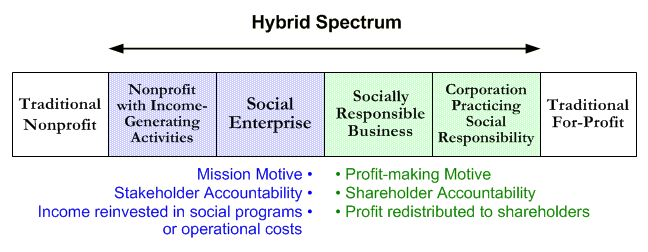
- 1Adapted from Tom Reis, Unleashing New Resources and Entrepreneurship for the Common Good: A Scan, Synthesis, and Scenario for Action. W.K. Kellogg Foundation, January 1999.
- 2Adapted from Gregory Dees, Why Social Entrepreneurship is Important to You, from Enterprising Nonprofits: A ToolKit for Social Entrepreneurs, John Wiley and Sons, 2001; and Lee Davis and Nicole Etchart, Profits for Nonprofits, NESsT, 1999.
- 3Adapted from Etchart, Nicole and Lee Davis, Profits for Nonprofits, NESsT, 1999.
Nonprofit with Income-Generating Activities
Nonprofit with Income-Generating ActivitiesNonprofit organizations that incorporate some form of revenue generation through commercial means into their operations. Income-generating activities are not conducted as a separate business, but rather are integrated into the organization's other activities.These activities usually realize little revenue relative to the organization’s overall budget and traditional fundraising contributions.
There are two types of income-generating activities, delineated here by purpose:
When is an Earned Income Activity a Social Enterprise?
Is it the size of the income-generating activity; the amount of revenue earned; its legal structure, or type of staff involved that determines whether or not a income-generating activity can be considered a social enterprise? Though subtle, and subject to debate, the defining characteristic is that an income-generating activity becomes a social enterprise when it is operated as a business. The following characteristics apply: the activity was established strategically to create social and/or economic value for the organization. It has a long-term vision and is managed as a going concern. Growth and revenue targets are set for the activity in a business or operational plan. Qualified staff with business or industry experience manage the activity or provide oversight, as opposed to nonprofit program staff.
More than half of all nonprofits are engaged in some form of income generation, though few have the tools, knowledge, expertise or desire to develop these activities into enterprises, thus realizing their potential social and economic benefit for the organization. The example below demonstrates how elephant waste was turned into an earned income activity in one zoo and a social enterprise in anther.
An Example of Earned Income Activity versus Social Enterprise
The National Zoo in Washington DC sells Elephant dung to the public as exotic fertilizer. Although the humorous product is popular among local organic gardeners, the "Zoo Doo" venture is not treated as a business and the income it earns is insignificant. Opportunities to scale Zoo Doo into a viable enterprise by selling the product in nurseries and gardening catalogues, as well as adding other "zoo products" to the line have not been realized. Instead Zoo Doo functions as an innovative public relations and marketing strategy used to attract visitors and patrons to the National Zoo. The small amount of money it generates is considered a plus.
Using the same raw material, Zookeepers in Bangkok, Thailand turned their Elephant dung into lucrative business. The Thais transform the animal excrement into high-quality handmade paper which are sold in stationary stores, nature shops, and used in premium paper products in domestic and export markets. The enterprise employs several people who process the organic pulp to produce handmade paper. To keep up with demand, Thai zookeepers source dung from other zoos and elephant habitats. Unlike Zoo Doo, the Elephant dung products are not advertised to consumers as such; rather, socially-conscious consumers are sold on organic nature of the product and the fact that proceeds from sales are used to fund zoo activities and animal protection organizations.
Social Enterprise
Social EnterpriseA social enterprise is defined as any business venture created for a social purpose--mitigating/reducing a social problem or a market failure--and to generate social value while operating with the financial discipline, innovation and determination of a private sector business.1
Social enterprises use entrepreneurship, innovation and market approaches to create social value and change; they usually share the following characteristics:
- Social Purpose - created to generate social impact and change by solving a social problem or market failure;
- Enterprise Approach – uses business vehicles, entrepreneurship, innovation, market approaches, strategic-orientation, discipline and determination of a for-profit business;
- Social Ownership – with a focus on public good and stewardship, although not necessarily reflected in the legal structure.
Social enterprises may be structured as a department within an organization or as a separate legal entity, either a subsidiary nonprofit or for-profit.
The purpose of the social enterprise may be:
- an additional funding mechanism for the organization’s social programs or operating costs;
- a sustainable program mechanism in support of the organization's mission; or
- a leadership development mechanism in support of social innovation.
Used for either purpose, business success and social impact are interdependent.
Social enterprises can be classified based on their mission orientation...
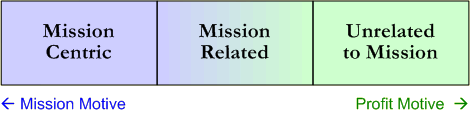
...as well as the level of integration between social programs and business activities.
- 1Definition from Virtue Ventures LLC
Socially Responsible Business
Socially Responsible BusinessFor-profit companies that operate with dual objectives-making profit for their shareholders and contributing to a broader social good. Ben and Jerry's and Body Shop are examples of this type of hybrid.1
In socially responsible businesses the degree to which profit-making motives affect decisions and the amount of profit designated for social activities ranges. Socially responsible businesses are willing to forsake profit or make substantial financial contributions rather than distribute earnings privately, and frequently place social goals in their corporate mission statements. In some cases a socially responsible business may be considered a social enterprise when it is a registered for-profit subsidiary owned by a nonprofit organization (parent organization) created for the purpose of earning income for the parent organization as well as supporting a social cause.
For additional information, see the Business for Social Responsibility web site.
Green Mountain Coffee Roasters, an example of Socially Responsible Business
Green Mountain Coffee Roasters (GMCR), based in Vermont, is an example of socially responsible company. At GMCR every business decision is anchored in the company's core values concerning the environmental and the social impact of its business actions.
In 1989, GMCR established an environmental committee comprised of employees to explore the many ways its corporate environmental vision could be executed in its business practices. One outcome was the establishment of the Company's extensive on-site recycling program.
In 1992, GMCR launched its "Stewardship" line of coffees, which are grown and harvested using ecologically-sound sustainable farming techniques beneficial for the land and workers. GMCR employees travel to coffee farms in Hawaii, Mexico, Costa Rica, Peru, Guatemala, and Sumatra to evaluate the farm management and quality of the coffee. These visits help develop strong relationship with the growers and better profits.
In 1997, GMCR funded construction of a "beneficio and hydro" plant for 16 coffee-farming families in Peru. Then in 1998, the Company provided funding for a Coffee Kids micro-lending project in Huautsco, Veracruz, Mexico. This project has already grown to include over 270 participants.
In addition to these socially responsible business activities, GMCR contributes 7.5% of its pre-tax earnings, the highest amount allowable by law, to social and environmental organizations such as Conservation International.
- 1Young, Dennis, Social Enterprise in the United States, 2001.
Corporation Practicing Social Responsibility
Corporation Practicing Social ResponsibilityFor-profit businesses whose motives are financially driven, but who engage in philanthropy. "Strategic philanthropy" helps companies achieve profit maximization and market share objectives while contributing to public good.
A private company or corporation engages in socially beneficial activities such as grant-making, community involvement, volunteering company personnel, and sponsorship as a means to improve public image, employee satisfaction, sales, and customer loyalty.
Corporate social responsibility is not classified as social enterprise, although philanthropic activities may support social enterprises, make a positive social impact, or contribute significantly to a public good.
Amanco, an example of Corporate Social Responsibility
Amanco, part of the Nueva Group based in Costa Rica, produces and markets piping for irrigation construction, infrastructure, and industry in 13 countries of Latin America.
Amanco Argentina has two plants, including one at Pablo Podestá where the company started a community integration program in 2000. They are working with the Agrupación Ecológica Oasis (Oasis Group), which brings together needy youth for local activities, including reforestation and tree planting, and collecting aluminum, glass, and newspaper that they sell to recycling companies. The money is used to buy school supplies, tools, seeds, and other items. The company provides them with a space to create a library and meeting center, for which Amanco employees collected the first books. Employees will also teach classes.
Amanco identified community leaders who will be trained to continue the work organized by the Oasis Group, and plans to bring other companies in the region into the program, which will be expanded to work with other local community groups.
Dual Value Creation
Dual Value CreationTwo distinct families of organizations reside on the hybrid spectrum. The characteristic that separates the two groups is purpose.
Profit (shareholder return) is the primary purpose of socially responsible businesses and corporations practicing social responsibly, whereas social impact is the primary purpose of social enterprises and nonprofits with income-generating activities. This difference is central to the organization’s ethos and activities. For this reason, organizations rarely evolve or transform in type along the full spectrum. Those that transform from social enterprise to socially responsible company or visa-versa must first reorient their primary purpose then realign their organization.
Nonprofits are founded to create social value, however, financial sustainability cannot be achieved without external or self-generated funds. For-profits are established to create economic value, yet often must make social contributions to survive in the marketplace. Therefore, both types of hybrids pursue dual value creation strategies to achieve sustainability equilibrium. Nonprofits integrate commercial methods to support their social purpose and for-profits incorporate social programs to achieve their profit making objectives.
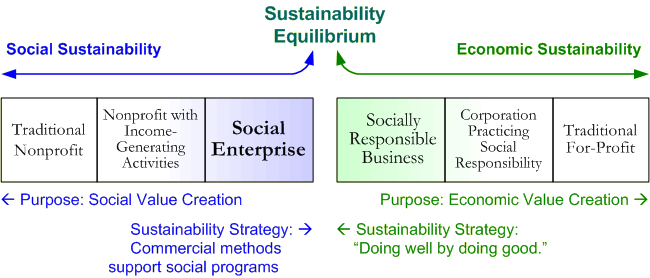
As a hybrid, the social enterprise is driven by two strong forces. First, the nature of the desired social change often benefits from an innovative, entrepreneurial, or enterprise-based solution. Second, the sustainability of the organization and its services requires diversification of its funding stream, often including the creation of earned income.1
Distinguished by their dual value creation2 properties--economic value and social value--social enterprises have the following characteristics:
- Use business tools and approaches to achieve social objectives
- Blend social and commercial capital and methods3
- Create social and economic value
- Generate income from commercial activities to fund social programs
- Market-driven and mission-led
- Measure financial performance and social impact
- Meet financial goals in way that contributes to the public good
- Enjoy financial freedom from unrestricted income
- Incorporate enterprise strategically to accomplish mission
Duality of Objectives
 Social Objectives aimed at mission accomplishment (social value creation) vary widely depending the organization’s mission and sector. Examples include economic opportunities for the poor, employment for the disabled, environmental conservation, education, human rights protection, strengthening civil society, etc.
Financial Objectives focused on financial sustainability (economic value creation) vary according to funding needs and business model. Financial measures are drawn from both private and nonprofit practice. Examples include cost recovery of social service, diversifying grant funding with earned income, self-financing programs or making a profit to subsidize the organization's operations.
Blended Value
The concept of "blended value"4 arises from the notion that value has within it three component parts: economic, social, and environmental. While traditionally people have thought of nonprofits being responsible for social and environmental value and for-profits for economic value; in fact both types of organizations generate all three value sets.
The rise of social enterprise, corporate social responsibility, social investing, and sustainable development are all examples of how various actors are pursuing a blend of financial, social, and environmental value.5 The blended value proposition is drawn from the belief that "value" is inherently whole; hence this school of thought is moving from measuring multiple bottom lines to focusing on a single value sign-blended value-or "total value" creation.
More information about Blended Value is available on the Blended Value Map website.
- 1Reis, Tom. Unleashing New Resources and Entrepreneurship for the Common Good: A Scan, Synthesis, and Scenario for Action. W.K. Kellogg Foundation, January 1999.
- 2Formerly referred to as double bottom line concept; double bottom line was dropped in favor of a new more holistic value creation approach (see blended value). Many proponents of social enterprise, social investing, corporate social responsibility, and venture philanthropy subscribe to the triple bottom line which includes environmental impact along with economic and social impact. The intent of this typology is to simplify the concepts, rather than to discount the significance of environmental impacts. For our purposes environment impacts have been included within social impact category.
- 3Adapted from Gregory Dees, Enterprising Nonprofits, Harvard Business Review, January-February 1998.
- 4For more information see, Blended Value Proposition: Integrating Social and Financial Returns, California Management Review, Vol. 45, No. 4, Summer 2003.
- 5Excerpted from Mapping the Blending Value Proposition, Jed Emerson and Sheila Bonni, 2003.
Mission Orientation and Motives
Mission Orientation and MotivesIn hybrid organizations money and mission are intertwined like DNA; however, they are not always equal partners. In practice, financial and social objectives are often in opposition or competition with one another. The initial decision to undertake a social enterprise is frequently motivated by either financial need or mission benefit.
Mission Orientation in Hybrid Organizations
The following diagram shows the relationship between mission orientation and type of organization.
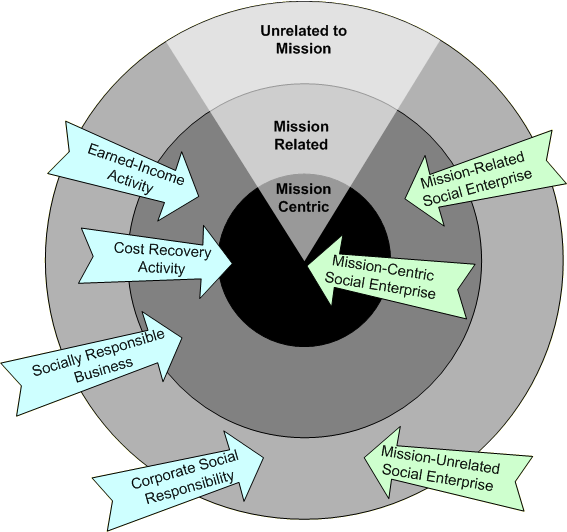
Mission vs. Profit Motives in Hybrid Organizations
The following scatter diagram shows the relationship between the type of organization and its motives.
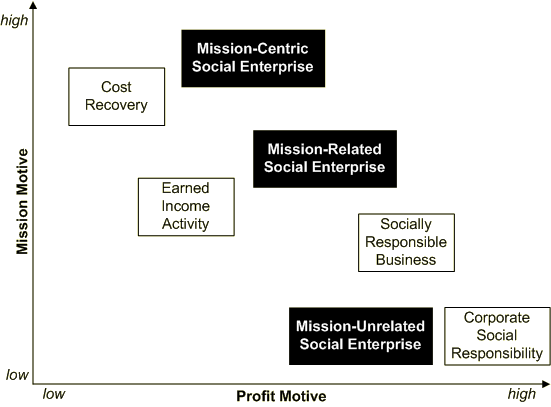
Mission Drift
Mission DriftThe inherent challenge of operating a social enterprise is managing to its dual objectives. In practice, the business of generating social and economic value means decisions and actions are in frequent opposition. This translates into calculated trade-offs: decisions to forsake social impact to gain market share or increase profit margins; or conversely, expanding the scope of social good at a financial cost. Problems occur when an organization's enthusiasm to meet its financial goals begins to overwhelm its social mandate. Nonprofits' long history of struggling to secure funding can, in the advent of earned income, threaten to swing the pendulum too far in the other direction. In the early days of microfinance, donors and practitioners toiled to set parameters on "how far is too far" on the mission-money spectrum by quantifying loan sizes, duration of client relationships, and interest rates before arriving at a model that was both viable and scaleable.
The concern many nonprofit practitioners and donors face is that incorporating commercial approaches into a nonprofit will compromise the organization's mission or social services by causing a "drift" too far into the for-profit camp.
The feared results of the "drift" (real or perceived) are:
- drift may damage the reputation of the organization among stakeholders and the public;
- the social enterprise may jeopardize funding because donors either misunderstand its dual-intention social enterprise or believe donations are now unnecessary;
- it may threaten organizational culture by applying market-based approaches and bringing in business professionals and industry experts; and
- finally, some fear that the organization will lose focus, and stray too far into the commercial realm, neglecting its social mission.
Running a social enterprise is a balancing act, which requires vigilance and a clear understanding of the organization's purpose and priorities: what is the social impact that the organization is trying to achieve, and how much money does it need to make? It means strong market discipline coupled with an equally strong sense of ethics and integrity--and leadership consensus about limits on "how far is too far" in any direction. Generating economic value, or making money, is not an evil act; on the contrary, it's a tool for generating social value in a way that is more sustainable than relying on donor funds.
The social enterprise model and design will largely inform how its dual purposes are achieved; it is up to the leadership to manage the tensions. The following exhibit shows this relationship in the product and market mix.
Existing Product; Existing MarketIncome directly from social programs
Income is earned directly from nonprofit program activities. Nonprofit sells existing social service and products to its target market or to a third party payer on behalf of target market. Income covers the cost of service delivery and may fund all or a portion of overhead. Example: A microfinance institution sells micro-loans to low income microentrepreneurs. Income from interest and fees is used to cover the service delivery costs as well as the operating and financial costs of the microfinance institution. Highest mission relevance; lowest risk |
New Product; Existing MarketIncome from extension of social program
Income is earned by enhancing nonprofit program activities. Nonprofit sells new products and services to its existing target population or constituents. Income covers the cost of service delivery and may fund all or a portion of overhead. Example: In addition to its educational and advocacy programs, a biodiversity organization adds an exhibit hall to its offices. Visitors pay admission fees, which fund the operating costs of the exhibit as well as a portion of the organization's overhead. High mission relevance; medium risk |
Existing Product, New MarketIncome related to social program
A nonprofit commercializes its existing social services or products and sells them in the open market to the general public or businesses (other than to clients/constituents). Income subsidizes social programs and parent organization overhead. Example: A senior services organization provides grant-subsidized care management services to poor seniors, and sells the same services in its eldercare business to a private pay market. Income generated from the private eldercare business is used to subsidize social program costs and a portion of the parent organization's overhead. Medium mission relevance; medium risk |
New Market, New ProductIncome not related to social program
A nonprofit sells new products or services in a market other than to its target population or constituents. The decision to use this mix is financially motivated. This type of social enterprise most often takes the shape of auxiliary or unrelated businesses, and its income is used to fund social programs and the parent organization at-large. Example:
A youth organization owns a real estate holding company with several commercial rental properties. Space is rented to tenants that have no relationship with the commercial activities of the youth organization. Profit from the real estate business is used to fund the youth organization's overhead and programs. Low mission relevance; high risk |
Financial Strategy
Financial StrategySocial enterprise is a means to achieve sustainability through earned income; however, it is important to note that financial objectives differ among organizations. Unlike the microfinance field, the financial objective of a social enterprise is not by default viability (generating sufficient income to cover all costs).
Social enterprises don't need to be profitable to be worthwhile. They can improve efficiency and effectiveness of the organization by:
- reducing the need for donated funds;
- providing a more reliable, diversified funding base; or
- enhancing the quality of programs by increasing market discipline. 1
Nonprofit organizations have varying financial motives for incorporating social enterprises into their organizations, ranging from income diversification to full financial self-sufficiency:
- Income Diversification -- For many nonprofit organizations, social enterprise serves as a strategy to diversify their funding base, decrease reliance on donors, and recover or subsidize program costs. In these cases, the social enterprise offers a means to reduce program deficits and employ resources more efficiently. Organizations seeking means to diversify income may set modest financial objectives. For example, the costs of a program previously 100% grant-funded now covered 40% by earned income is success for many organizations.
- Financial Self-Sufficiency -- Financial self-sufficiency is achieved by increasing nonprofit organizations' ability to generate sufficient income to cover all or a substantial portion of their costs or fund several social programs without continued reliance on donor funding. Organizations seeking to maximize profit will opt for external subsidiaries expressly for the purpose of funneling money back to the parent organization. Experienced nonprofits may use complex structures and have multiple mixed enterprises and income streams.
- Cost Savings and Resource Maximization -- This financial objective is usually combined with financial self-sufficiency or income diversification and is concerned with optimizing resources and leveraging assets for economic, social, and community development.
- Cost savings--is achieved by sharing back office functions, optimizing systems, and streamlining efficiencies to increase business performance and margins.
- Resource maximization--is achieved through leveraging the nonprofit's financial assets, tangible assets (space, equipment, plant, building, etc.), and intangible assets (proprietary content, methodology, relationships, goodwill, name recognition, skills, and expertise).
- 1Dees, Gregory, Enterprising Nonprofits, Harvard Business Review, January-February 1998.
Financial Spectrum of Social Enterprise
Financial Spectrum of Social EnterpriseThe level of social enterprise self-sufficiency is based on financial objectives, the type of enterprise, and its maturity. Social enterprise methodology does not dictate breakeven or profit-making; rather, financial performance is appraised by the ability of the social enterprise to achieve the financial objectives it has set.
For this reason, the chart below1 does not represent gradation from one stage of development to the next, unless the social enterprise's express objective is to move across the continuum and performance is a question of maturity.
| Organizational Structure | Traditional Nonprofit | Traditional Nonprofit / Social Enterprise | Social Enterprise | Social Enterprise | Social Enterprise |
| Financial Spectrum | Full Philanthropic Support | Partial Self-Sufficiency | Cash Flow Self-Sufficiency | Operating Self-Sufficiency | Financial Self-Sufficiency |
| Level of income | No earned income. Relies on subsidies for financial support to sustain operations. | Earned income covers a portion of operating expenses or recovers some program costs. | Earned income covers operating expenses of enterprise at lower than market rates. | Earned income covers all operating expenses without full market-based costs (capital & investments). | Earned income covers all operating and investment expenses at market rate. |
| Subsidy | 100% subsidy. | Enterprise and/or parent organization mostly subsidized. | Bridges deficit between earned income and expenses, capital investment and growth subsidy. | Cost of capital, partial subsidies for loans, and capital expenditures. | No subsidies. |
| Viability through earned income | Not viable. Requires continued external financing (grants). Cost recovery is often seen as a side benefit rather than an expectation of the program. | Not viable. Organization is dependent on grants and donations for survival; may self-fund isolated services or activities. | Approaching viability. Covers direct costs; cost structure and growth subsidized; revenue covers daily operations until breakeven. | Viability expected. Operational breakeven; no surplus revenue, subsidies diminish; revenues cover all operating costs. | Viable to profitable. Revenues cover all operating and financial costs; retained earnings finance growth. Nonprofit may change its legal status to that of a for-profit entity. |
| Type of subsidies |
|
|
|
|
|
- 1Expansion on spectrum idea presented by Gregory Dees, Enterprising Nonprofits, Harvard Business Review, January-February 1998. Adapted from, Alter, Sutia Kim, Managing the Double Bottom Line: A Business Planning Resource Guide for Social Enterprises, Pact Publications, Washington, DC, 2000.
Methods of Income Generation
Methods of Income GenerationSocial enterprises use a variety of methods to generate commercial income to sustain operations. At any given time, a social enterprise may use one or a combination of methods, based on the type of enterprise and business strategy.
| Method | Description | Examples |
| Fee-for-service | Charging constituents or clients for social services in order to recover costs of service provision. | Museums charge entry fees; microfinance institutions sell financial services; rural clinics collect sliding scale fees for doctor visits. |
| Products | Earned income through manufacturing and product sales, or through mark-up and resale of products. | Horticulture cooperative sells flowers wholesale to suppliers; a fair trade company imports cocoa beans and manufactures them into chocolate products to sell in western markets; a handicraft marketing company sells artisan products through a catalogue and takes a commission on sales; a café employing disabled people sells coffee and snacks to the public. |
| Services | Commercialization of a skill or expertise to a market willing and able to pay. | Hunger relief organization sells catering services to schools and institutions; children's education organization provides daycare service for a fee; mental health organization sell psychotherapy and counseling services; a national microfinance institution sells management consulting services to other nonprofit organizations interested in starting credit programs. |
| Membership Dues | Fees collected from members of a group, association, or organization in exchange for services such as a newsletter, discounts, conferences, insurance, etc. | Dairy subsector trade association provides market information and linkages to its paying members; organization of social enterprise practitioners receives newsletter, listserv, industry reports, job listings, and an annual conference in exchange for an annual fee. |
| Tangible Assets | Generating income by renting or leasing a tangible asset such as office space, building, land, vehicles, or equipment. | Human services organization leases its idle office space to another nonprofit organization; a community development organization rents its trucks to a moving company on the weekends; an environmental conservation organization leases its land to an eco-touring organization. |
| Intangible Assets | Generating income by leveraging an intangible asset such as proprietary content, methodology, brand, reputation, relationships, goodwill, etc. | International Children's organization licenses its logo and brand name to a clothing line; a university obtains research contracts for scientific study from technology companies; a membership organization sells its mailing list; a youth news agency sells its print content to an online educational service targeting young people. |
| Investment Dividends | Passive income earned from investments. | Interest income and dividends from bonds, stocks, savings deposits, and other investments. |
| Unrelated Business Activities | Revenues from a business unrelated to the organization's mission and created for the purpose of funding specific social activities or the organization at-large. | Museum shop or retail store of an environmental organization; Girl Scout cookies; a catalogue trinket business supporting a public radio station; nonprofit real estate holdings. |
Access to Capital
Access to CapitalSocial enterprises, like any other business--micro or corporation, need capital to grow. It's not only a question of financing, but also of the right kind; capital must correspond to social enterprise financial needs, business cycles, and maturity. Furthermore, like any other business, the best make good use of borrowed capital and their own risk capital.
Access to capital, however, is a constraint social enterprises continue to face. The reasons are fourfold:
- Nonprofit capital markets are immature and underdeveloped, and there is little availability of financial instruments appropriate for capitalizing nonprofit businesses.
- Ownership and regulatory issues bar nonprofits from access to financing--they cannot issue equity or distribute profits.
- Nonprofit managers are financially risk adverse and hence often steer clear of options to leverage or borrow funds in order to capitalize their enterprises.
- For the nonprofit manager willing to borrow, the lack of collateral, credit history, or financial competence are other factors that prohibit access.
Market Maturity
Market maturity and limited available resources present significant problems. Agencies such as the Inter-American Development Bank and social investors such as Calvert Foundation or Partners for the Common Good have worked to fill funding gaps with low interest loans and innovative financing programs, such as SEP.
On the other hand, few donors have come to the table to fund start-up or early stage social enterprise with grants. In cases where donors have funded social enterprises, the philanthropic funding cycle is typically slower than the social enterprises' business cycle (production and sales cycle), which can further challenge capitalization.
To exacerbate matters, there is the worrisome misconception that once an organization has launched a social enterprise, it no longer needs grants for social programs, when in fact early capitalization of the enterprise dictates the opposite. There is also the misperception that social enterprises only need loans. Capitalizing a nonprofit social enterprise may take four or five times longer than its private sector counterpart, due to the social costs and encumbrances of supporting dual objectives. These financial limitations hinder efforts of many social enterprises to take their activities beyond the start-up stage and to stabilize, expand, and diversify. 1
Funding Instruments
Appropriate funding instruments and greater awareness of capitalization issues is needed to facilitate the growth of the social enterprise field as a viable sustainability strategy for nonprofits. Assisting the development of social enterprises' capital markets is a role that onors, philanthropists, and local governments can play. The following exhibit shows the range of funding across the nonprofit and for-profit spectrum. Many of the same funders support both traditional nonprofit and hybrid nonprofit enterprises; however, greater participation and diversity of funding instruments are needed in the latter if this field is to emerge as a mainstay of international development.
Funding Spectrum2
| Type of Organization | Traditional Nonprofit | Social Enterprises | Socially Responsible Companies | For-Profit |
| Capital | Grants and donations | Mix of grants and below market capital No interest or low- interest loans | Market rate capital (including social responsible investments) | Market rate capital |
| Sources of Capital and Investors |
|
|
|
|
| Investment Objective | High social return--no expected financial return | High social return with below market or no financial return | Market rate of financial return and some social return | Full market rate of financial return and no expected social return |
- 1Etchart, Nicole and Lee Davis, Unique and Universal: Lessons from the Emerging Field of Social Enterprise in the Emerging Market Countries, NESsT, 2003.
- 2Adapted from Emerson, Jed and Sheila Bonni, The Blended Value Map: Tracking the Intersects and Opportunities of Economic, Social and Environmental Value Creation, September, 2003, www.hewlett.org
External Financing vs. Revenues Over Time
External Financing vs. Revenues Over Time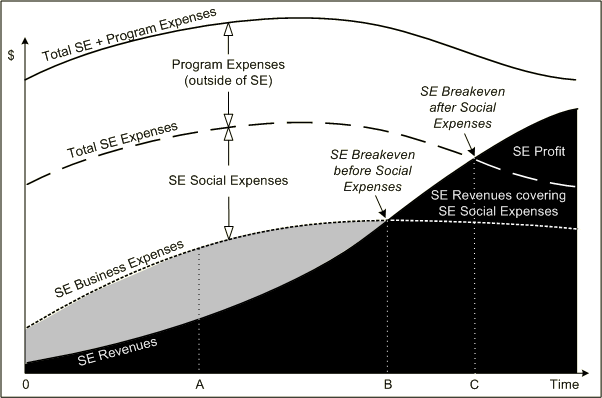
Legend: SE = Social Enterprise; Y Axis = Money; X Axis = Time;
External Financing = all financing (grants, loans, contributions) minus revenues (internal financing)
Total expenses can be divided into three subcategories (moving upward along the Y-axis):
- SE Business Expenses include all costs found in similar businesses that are strictly for-profit, with no consideration for social impact and mission.
- SE Social Expenses comprise additional expenses incurred because of the social focus of the SE, such as special workplace or benefits requirements. Together, the SE Business Expenses and the SE Social Expenses total the total SE expenses.
- Program Expenses, in this context, represent expenses incurred to support social programs outside the SE.
From Time 0 to Time A (moving along the X-axis), the SE goes through a start-up phase requiring a lot of external financing. Expenses increase faster than revenues. This is a critical phase during which decision-makers must carefully weigh business expenses based on their potential for generating future revenues.
From Time A to Time B, the SE goes through a growth phase during which external financing is still required, but revenues grow at a faster pace than expenses, leading the way to traditional financial sustainability.
The SE reaches its first breakeven point in Time B, at which point the SE becomes sustainable as a traditional business (a business that does not incur additional social expenses). The difference between all Business Expenses and Revenues between Time 0 and Time B represent the total business investment over that period of time (light gray area on the chart). Even the best management team implementing the best business model cannot succeed in bringing a business to that critical point if decision-makers fail to recognize (and budget) the level of external financing that will be required over that certain period of time, both of which can vary greatly based on a variety of factors (all of which are considered during the business planning phase).
From Time B to Time C, the SE still requires external financing, but only to cover part of its Social Expenses (part of which is also covered by SE Revenues). Depending on the model, some social enterprises never grow beyond that point, in which case they serve in a context in which both SE Revenues and external social subsidies can be effectively leveraged to create social impact.
In Time C, the SE might be reaching a second breakeven point, at which all SE expenses are covered by revenues. Additional SE revenues now generate a profit that can fund social programs outside of the SE.
Program Strategy
Program StrategyFrom a programmatic perspective, social enterprise addresses one of the most pressing issues nonprofit organizations face--how to achieve ongoing sustainable impact. In some organizations social enterprise is highly compatible with the mission and hence, is a natural program fit. For example, program activities concerned with economic development revolve around work and wealth creation. The missions and objectives of social welfare and human development organizations focused on employment training and welfare-to-work transitioning also mesh neatly with social enterprise as a program methodology. Agricultural organizations offer ample opportunities to marry program activities of sustainable crop cultivation and livestock rearing with social enterprises that process food or sell fair trade products, etc. In these cases, organizations often employ embedded and mission-centric social enterprises as a principal program strategy to accomplish their missions while simultaneously increasing their financial self-sufficiency.
Opportunities to utilize social enterprise as a program strategy may be less evident in some organizations than in others. Here social enterprise is an auxiliary activity that compliments or expands the organization's mission and social activities, but is not the core social program. For example, an arts-and-culture organization may commercialize its products--i.e. sell art--, yet its primary activities are education and training programs aimed at preserving traditional artisan crafts methods. An environmental organization may launch an eco-tourism enterprise as a vehicle to educate people about environmental conservation and employ community members but its main social activities are concerned with reforestation and anti-erosion.
Where social enterprise is not a seamless match with an organization’s mission, the impetus to begin a social enterprise might be financially motivated, nevertheless the social enterprise may enhance or compliment the organization’s social programs and strengthen its mission. In these cases, social enterprises are often integrated within the organization, their activities related to the mission, but are not used as a core program strategy to accomplish the mission.
Program Areas
Program AreasProgram activities described in this section are not comprehensive, rather they relate only to social enterprise programs. All technical program areas have numerous activities not elaborated herein.
Economic Opportunities
Economic opportunities programs focus on starting social enterprises for the express purpose of creating fair-wage jobs or employment opportunities in a geographic target area. Other program activities center on developing transferable skills, job placement, or opportunities that foster self-employment. Economic opportunities programs may be single-focused on business or integrated with other social services such as insurance, literacy, health education, etc.
Community and Rural Development
Community and rural development programs develop community-based social enterprises aimed to provide local jobs, increase purchasing power, reduce urban flight, increase community wealth, and strengthen community cohesion. These social enterprises may be designed as community businesses intended to benefit the entire community by investing surplus revenue in wells, schools, libraries, community centers, gardens, etc., or as more traditional small and medium scale enterprises (SMEs).
Market Development
Market development programs start or support social enterprises that spur and facilitate growth in underdeveloped and under-served markets. These social enterprises operate in markets that are unattractive to private companies due to high market penetration costs (often related to rural distribution and educational marketing), slim margins, or both. The objective is to provide access to vital good and services to marginalized communities while strengthening markets to entice private sector players. Social enterprises working in market development consider private sector competition or cannibalization an exit strategy. Socially responsible fair trade organizations also serve to develop markets, but do not seek to exit markets based on emerging competition.
Access in Under-served Markets
In markets unattractive to the private sector, but where social need and demand coexist, the social enterprise fills a vital niche by providing access to products and services. Poor and rural markets are largely under-served due to high transaction costs, low purchasing, and low margins, making access difficult for many people in need of products and services, such as medical services, health inputs, financial services, etc.
Employment Development
Employment development creates employment and vocational training for disenfranchised, disabled or at-risk populations. These so-called "hard-to-employ" people earn a livable wage and develop marketable skills through their employment in the social enterprise. Employment development models of social enterprises were popularized in the US, and have proven successful in Latin America.
Microenterprise Development
Programs that foster the growth and development of microenterprises (businesses that employ 1-10 people) and self-employed people (microentrepreneurs) through the provision of affordable credit or business support services (training, technology, market information, etc.)
Institutional and Organizational Development
Institutional development programs are aimed at building the capacity of nonprofit organizations to self-govern and become sustainable. In addition to training and technical assistance in organizational development and nonprofit management, programs focus on income-generation and financial self-sufficiency, thus may incorporate social enterprise.
Sectors
SectorsThis section describes a number of nonprofit sectors and some social enterprise applications in those sectors. This is by no means an exhaustive list; social enterprise can be applied in any nonprofit sector, particularly if is it used as a financing strategy. The sectors highlighted in this section are generally conducive to incorporating social enterprise as a program strategy.
Economic Development
Economic development is a sector that uses social enterprise as a sustainable program strategy to create economic opportunities and community wealth-building to enable poor people to attain economic security for themselves and their families. In many cases, business activities are "embedded" within the economic development organization; the social enterprise is the program--the means to effect social impact. Some of the possible social impact goals include increased household income, asset accumulation, investments in productive activities, job creation, increased school attendance, improved health, and quality of nutrition.
Environmental Conservation
"Eco enterprises" offer a wealth of creative methods to both raise money for, and awareness of, environmental issues. Eco-tourism's growing popularity provides lucrative opportunities to social entrepreneurs interested in capturing intrepid travelers. The tourist market, unlike many nonprofit "client markets," has money; therefore this business easily marries the social enterprise's financial and social objectives. Many environmental social enterprises also sell products, such as shade-grown coffee or items made from recycled materials. In other examples, environmental social enterprises operate organic markets or home delivery food businesses to finance sustainable agriculture and education programs.1
Social Welfare and Human Development
In some social welfare and human development organizations, there is crossover with employment development and job training programs, whereby the social service organization creates jobs and develops skills for clients--homeless, physically and mentally disabled, and at-risk populations--through a social enterprise. Human development organizations that target recovering drug addicts and alcoholics, former welfare recipients, or ex-convicts use social enterprises as rehabilitative programs. In other cases, the social welfare organization may commercialize its social services to a private pay market to fund its programs.
Arts and Cultural Preservation
Within the context of the cultural organization, social enterprise offers a range of possibilities to serve social and financial objectives. Selling cultural products through outlets such as an art gallery, cinema or theater; or educational services such as art, drama, music, cultural history, etc. are common social enterprise examples.
Health
In the health sector, nonprofit organizations have been incorporating social enterprise for many years. Hospitals and clinics are common examples. Pharmacies, medical supply companies, and group-purchasing businesses are also widely applied models. Selling health services is a growing industry in social enterprise: nutrition counseling, physical therapy, mental health counseling, care management, and alternative therapies.
Agriculture
Agricultural production, sustainable farming, food processing and animal rearing offer many social enterprise opportunities for rural communities in developing countries where few other economic opportunities exist. In the United States, social enterprises in the agricultural sector range from nonprofit or cooperative organic farms to economic development organizations that support entrepreneurs and small scale producers (cheese, jam, salsa, beer, etc.).
Education
Educational institutions have long used social enterprise as a means to diversify their income and strengthen education programs. Tuition or "fee-for-service" is the obvious method used by schools, colleges and universities. Many universities obtain research contracts with the government or private sector. Specialized skill or technology institutions provide an option to follow the service subsidization model by repackage classic education to new markets for a fee.
Children and Youth
Many nonprofit organizations serving adolescents and young adults, particularly from low-income families, conduct entrepreneurship and vocational skills training, or run hands-on business programs such as youth run enterprises or incubators. These types of program provide multiple opportunities for integrating social enterprise programs within the organization. Other children and youth organizations operate child-focused enterprises such as birthday parties, camp, after school programs, test preparation, tutorials, classes, extra curricular activities and sports.
Democratization and Governance
Democracy and governance programs are concerned with facilitating democratic and self governed organizations, advocacy, enabling legal environments, human rights and rule of law. Although democracy and governance organizations are not an intuitive fit for a social enterprise program, many provide paid legal services, training, consulting to nonprofits, government bodies and private companies. Creative examples exist in this sector; one social enterprise sells encryption services to human rights organizations.
- 1Etchart, Nicole and Lee Davis, Unique and Universal: Lessons from the Emerging Field of Social Enterprise in the Emerging Market Countries, NESsT, 2003.
Social Enterprise Classification
Social Enterprise ClassificationSocial enterprises can be classified either based on their mission orientation or based on the level of integration between social programs and business activities.
Mission Orientation
Mission OrientationSocial enterprises can be classified based on their mission orientation.
Mission-Centric Social Enterprise
Mission-Centric Social EnterpriseThe enterprise is central to the organization's social mission. These social enterprises are created for the express purpose of advancing the mission using a self-financing model.
Organizations created to employ disadvantaged populations (employment development) and microfinance institutions are examples of this type of social enterprise.
Mission-centric social enterprises often take the form of embedded social enterprises.
Mouvement Paysan de Papaye, an example of Mission-Centric Social Enterprise
The mission of Mouvement Paysan de Papaye (MPP) in rural Haiti is "to establish at the community level cooperative enterprises that allow the peasants to advance economically." MPP's mission is the foundation of its social programs, guiding decisions ranging from which industries to enter, to how to design its business models.
MMP uses social enterprise as strategy to create economic opportunities for its clients through new jobs, by opening markets, and supporting self-employment. The organization's target population benefits from its social enterprises in four ways, as: employees, business owners, customers and community members. As well, MMP's enterprises achieve supplementary impact by mitigating another critical social problem its clients face: food insecurity.
In central Haiti, where food supplies are unreliable; little sustainable farming knowledge exists; and there is a lack of access to agricultural inputs, people often go hungry. To address this problem and accomplish its mission, MPP began three mission-centric cooperative enterprises: a bakery that makes and sells traditional Haitian flat bread, a farm, and a store that sells agricultural and farm inputs.
- The bakery provides 24 jobs for MMP’s clients in addition to a reliable food supply to the community.
- The store promotes sustainable cultivation and food production, and hence, fosters self-employment (farming) and creates more jobs.
- The third business, a 50-acre farm, grows produce and animal feed, and raises livestock, supplying the local population with a sustainable source of food and over a hundred jobs.
In sum, MPP's three businesses create nearly 200 jobs for local peasants and supply essential goods and services to the community.
Financially, the social enterprises are self-sufficient, not only covering their own costs, but earning a surplus which MMP uses to subsidize its literacy, advocacy, micro-loans, agricultural and education programs.
Mission-Related Social Enterprise
Mission-Related Social EnterpriseThe enterprise is related to the organization's mission or core social services. Mission-related social enterprises have synergistic properties, creating social value for programs and generating economic value to subsidize the organization's social programs and/or operating expenses.
Commercialization of social services is a common form of the mission-related social enterprise. One example is a family services organization that provides free meals to the children of low income families enrolled in the organization's day care programs. Utilizing its industrial kitchen, staff dietitian and cooks, the organization starts a catering business serving the "social institutional" market segment--schools, day care centers, hospitals willing and able to pay for this service.
Mission expansion is another type of mission-related social enterprise. An example is a women's economic development organization that supports self-employed single mothers through small business consulting services; and then expands its mission by opening a sliding-scale fee-based childcare social enterprise to permit its clients more time to focus on their business.
Mission-related social enterprises often take the form of integrated social enterprises.
Essential Eldercare, an example of Mission-Related Social Enterprise
IONA Senior Services is an example of a nonprofit organization that launched a mission-related social enterprise, Essential Eldercare. IONA is “dedicated to enabling older people to live with dignity and independence. Through its professional staff, corps of volunteers, and close collaboration with other organizations, IONA provides services and access to programs designed to meet the needs of seniors and their families.” IONA accomplishes its mission by providing free and subsidized eldercare services to low income elderly residents of Washington DC, which includes adult day care, fitness, computer classes, recreational activities, counseling, meals, etc.
IONA commercialized its core social services to start Essential Eldercare, a premier eldercare social enterprise, as a means to generate income to support the organization's nonprofit activities. Essential Eldercare (EE) sells premium eldercare services to middle and high income seniors in the greater Washington Metro area. Although there are marginal differences between the types of eldercare services rendered by IONA and EE, the main difference is the markets they serve, thus Essential Eldercare social enterprise's activities are related to IONA's mission. It's important to note that IONA's mission does not dictate the economic status of the seniors it serves. Therefore by expanding eldercare services into an affluent market, IONA is able to reach a greater number of seniors and increase its social impact.
EE is structured as a profit center within the nonprofit parent organization, IONA. Assets and synergies are leveraged across the nonprofit and social enterprise. For example, IONA rents office space and infrastructure (computer lab, fitness facilities, etc.) to EE; it also subcontracts IONA's social workers and eldercare specialists; and shares back office services and their related expenses, such as reception, intake and accounting. EE benefits from IONA's location, superb facility, name recognition and stellar reputation to sell its products. The inter-relationship between IONA and Essential Eldercare is evidenced in EE's mission: “to provide families premium quality eldercare services with compassion and integrity. By meeting the needs of an affluent target market, Essential Eldercare will generate excess revenue and capacity to serve more economically and socially disadvantaged frail seniors.”
Social Enterprise Unrelated to Mission
Social Enterprise Unrelated to MissionThe enterprise is not related to the organization's mission, or intended to advance the mission other than by generating income for its social programs and operating costs.
Business activities may have a social bent, add marketing or branding value, operate in an industry related to the nonprofit parent organization's services or sector, however, profit potential is the motivation for creating a social enterprise unrelated to mission.
Social enterprises unrelated to mission usually take the form of external social enterprises.
Save the Children's Licensing Program, an example of Social Enterprise Unrelated to Mission
Save the Children is an international development organization dedicated to creating real and lasting change for children in need. Save the Children was founded in 1932 and operates in over 40 developing countries and in 17 states across the United States. In addition to traditional nonprofit fundraising activities and child sponsorship, Save the Children has established a corporate licensing program to help fund its social programs and overhead. The first licensing agreement was negotiated in 1992 with an exclusive line of neckties featuring original artwork created by children. It would not be an exaggeration to say that today millions of Americans recognize the Save the Children name, logo and distinctive artwork on a host of products. Several dignitaries, including President Clinton, and have been photographed wearing Save the Children's ties and scarves.
Licensing relationships are sought with companies in consumer-related industries, based on the mutually beneficial goal of increased profit for companies and a significant and steady income stream for Save the Children's work worldwide. Licensees use Save the Children's name, logo to market their products. Enclosed with each licensed item is a tag that describes the organization's mission and work, which functions as a marketing vehicle for Save the Children. Corporate partners benefit from Save the Children's reputation to boost their image and to attract socially conscious consumers. Since the program's inception, Save the Children has developed licensing agreements with some 30 companies representing a wide range of products: infant wear, men's boxer shorts, bow ties, cummerbunds, eyeglass cases, mugs, cookie jars, checks, t-shirts, greeting cards, stationary, candles, puzzles, and women's silk scarves. Many of Save the Children's licensee's products have high visibility and are distributed through major retailers such as TJ Maxx, Nordstroms, Walmart and broadcast shopping channels such as Shop NBC.
Although unrelated to Save the Children's program activities concerning children's education, health, economic security, physical safety, etc., the licensing social enterprise generates a significant amount of unrestricted revenue ($4.5 million in 2003) and represents millions of dollars in marketing value for the organization. The licensing social enterprise is structured as a profit center within the organization along with other corporate partnership alliance programs such as cause-related marketing campaigns.
Business/Program Integration
Business/Program IntegrationSocial enterprises can be classified based on the level of integration between social programs and business activities.
Embedded Social Enterprises
Embedded Social Enterprises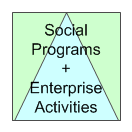 Social programs and business activities are one and the same. Nonprofits create Embedded Social Enterprises expressly for programmatic purposes. The enterprise activities are "embedded" within the organization's operations and social programs, and are central to its mission. Social programs are self-financed through enterprise activities and thus, the embedded social enterprise also functions as a sustainable program strategy.
Due to their mission focus, most embedded social enterprises are usually structured as nonprofits to protect against mission drift, but may also be registered as for-profits depending on the legal environment.
The relationship between the business activities and the social programs are comprehensive: financial and social benefits are achieved simultaneously.
Embedded social enterprises are usually mission-centric; the business activities are central to the organization’s mission.
Embedded social enterprises are evident in operational models where:
- social and economic activities are unified;
- social mission is the central purpose to the business; and
- the target population (clients) is integral to the model as direct recipients of social services (beneficiaries) and either the market (customers), employees or owners of the enterprise.
The following operational models often take the form of embedded social enterprise:
- Entrepreneur Support Model
- Market Intermediary Model
- Employment Model
- Fee-for-Service Model
- Cooperative Model
- Market Linkage Model
Equal Exchange, an example of Embedded Social Enterprise
Equal Exchange (EE) is a US-based fair trade coffee company legally structured as an employee-owned cooperative and an example of embedded social enterprise. Equal Exchange purchases coffee beans and cocoa directly from small democratically-run farmer cooperatives in developing countries at fair trade prices--a guaranteed minimum price regardless of how low commodities markets fall. Equal Exchange pays a fixed rate of $1.26 and $1.41 per pound for organic certified coffee in contrast to $0.45 and $0.60 per pound that buyers pay on the commodities market1
. The embedded nature of Equal Exchange's social programs is evidenced in its business activities.
Marketing strategy--the company uses educational marketing campaigns to raise awareness of the positive social impact purchasing fair trade coffee has on low income farmers. Equal Exchange's coffee packaging contains information regarding the social benefits of fair-trade purchasing.
Distribution channels--in addition to retail outlets, products are sold through interfaith organizations and nonprofits that educate their constituents about fair trade coffee; then retain a margin on each sale to support their social activities.
Quality products--Equal Exchange assists farmers with sustainable techniques to promote ecological-friendly cultivation of coffee. The results yield higher product quality, environmental conservation, and 85% certified organic fair trade coffee for consumers.
Social Impact--EE works with twenty-five trade partners, farmer cooperatives, in twelve countries, and achieves social impact in two significant ways: supplier credit and fair trade premiums.
- Supplier credit--Most cooperative farmers in developing countries do not have access to bank financing, and those that do pay 25%-35% interest. The more available option is moneylenders, who charge up to 100% of the price of the loan. EE offers pre-harvest credit at interest rates of 8% to 9%, which enables farmers to produce high quality crops without losing margins on the sale of their products. In 2001 EE extended $700,000 in pre-harvest credit to 75% of farmers who requested loans.
- Fair trade premiums have substantial impact on the economic security of farmers and their families, increasing disposable income for food, education, healthcare, housing, etc. EE pays farmers more than twice the going rate on the commodities markets. In 2002, EE paid $1.2 million in fair trade premiums to cooperative farmers. In a protracted commodity price slump, which has occurred in recent years, these premiums literally save thousands of lives by warding off starvation occurring in many coffee growing regions.
Financial strategy and viability--Its for-profit legal status notwithstanding, Equal Exchange's financial motives are viability, not profit; in 2002 the company had $10.4 million in sales, which translated into $1.2 million in above market premiums for cooperative farmers, and funded marketing activities that raised the awareness of tens of thousands of consumers who bought fair trade products. The dollar figures are a monetary representation of Equal Exchange's sustainable mission accomplishment.
Equal Exchange is a mission-centric social enterprise; its business decisions and activities are central to accomplishing its mission: "To build long-term trade partnerships that are economically just and environmentally sound, to foster mutually beneficial relations between farmers and consumers and to demonstrate through our success the viability of worker-owned cooperatives and fair trade."
- 1Statistics from 2002
Integrated Social Enterprises
Integrated Social Enterprises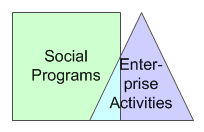 Social programs overlap with business activities, often sharing costs and assets. Organizations create integrated social enterprises as a funding mechanism to support the nonprofit's operations and mission activities.
In many cases integrated social enterprises expand or enhance the organization’s mission enabling it to achieve greater social impact. Mission expansion may be achieved by commercializing the organization’s social services and selling them to a new fee-paying market; or by providing new services to existing clients. Integrated social enterprises leverage tangible and intangible assets, such as expertise, program methodology, relationships, brand, and infrastructure, as the basis from which to create their businesses.
The integrated social enterprise may be structured as a profit center or enterprise department within the nonprofit, or as separate entity.
The relationship between the business activities and the social programs are synergistic, adding value--financial and social--to one another.
Integrated social enterprises are often mission-related; their business activities are connected to the organization’s mission.
Integrated social enterprises are evident in operational models where:
- social and economic activities overlap;
- synergies exist between the social activities and the economic activities, such as cost-sharing, asset leveraging, enhancing systems and expanding or strengthening the mission;
- the target population (clients) is a direct beneficiary of income earned from the social enterprise vis-à-vis the financing it provides to the social programs; clients may or may not be involved in the enterprise's operations as employees or customers.
The following operational models often take the form of integrated social enterprise:
Scojo India, an example of Integrated Social Enterprise
Scojo Foundation is health social enterprise specialized in eye care. Scojo's work is premised on the statistic that globally 80% of all people above the age of 35 suffer from presbyopia--blurry up close vision. In developing countries where optometry is a privilege of the middle income and wealthy, presbyopia can have a devastating affect on the productive activities of the poor, who typically have little access to eye care. Seamstresses, rug makers, weavers, mechanics, bookkeepers, automobile or bicycle repair people, hairdressers, and others with occupations that require up close vision can loose their livelihoods and their incomes if they suffer from presbyopia. Simple low-cost readymade reading glasses, or simple magnifiers, enable these people to continue to work.
Scojo Foundation founders began their program activities using a traditional nonprofit approach: distributing free readymade reading glasses to the target population in greatest need, the rural poor, but quickly learned that this model was not sustainable. In 2003, they launched Scojo India, an integrated social enterprise that operates in two distinct markets in Andhra Pradesh state: urban centers, targeting working and middle class customers; and rural markets, targeting poor and low income people. Although greater social need exists in India’s rural areas, and subsequently an opportunity to effect deeper social impact than in urban areas, Scojo’s business could not operate exclusively in rural markets without ongoing subsidy.
Characteristics of Scojo's urban market such as high population density, existing retail distribution, coupled with local purchasing power and product price elasticity indicate suitable conditions for a profitable ready-made eyeglass business. Scojo's rural market, on the other hand, has notoriously high costs to sell and distribute eyeglasses in sparsely populated areas to customers (target population) who lack the ability to pay. Therefore, Scojo India created a social enterprise that integrates its business activities. The urban market is the commercial side of the social enterprise's operations while the rural market is the social program side of the social enterprise.
Manufacturing--Products for both markets are manufactured in the same local nonprofit facility, and though style is differentiated in urban markets according to preferences, there is no difference in quality. Scojo transfers modern spectacle frame- and lens-making technology to its Indian partner, building local capacity to enable production of higher quality readymade glasses than are currently available in India. The production facility creates employment opportunities for local people.
Distribution and sales--Integration occurs at the level of the marketing function, but not in the sales activities. Scojo India set a total sales target of 266,760 low-cost readymade reading glasses in the first three years of operation (2003-2006); urban markets represent 75.4% of sales or 201,060 units and rural markets 19.6% or 52,200 units (government sales make up the remaining 5.1%). In urban areas Scojo uses teams of sales agents to sell readymade glasses to non-optical retail stores such as pharmacies, general stores, and bookstores. Sales agents are also dispatched in innovative mobile sales units, vans stocked with glasses, to bring reading glasses to local factories. Scojo India sells reading glasses to hospitals, health and microcredit NGOs, who channel the glasses through their existing network of community-based vision health workers or microentrepreneurs, making it possible for Scojo to penetrate the rural market. Scojo also sells reading glasses to the State Government for re-sale to their employees.
Financial strategy and viability--Scojo India uses a cross-subsidization strategy to achieve social objectives while achieving financial viability. Profits generated from urban sales subsidize price and distribution costs in rural areas where the need for affordable reading glasses is greatest. Glasses are priced at $2.50 for customers in rural areas and $5-$6 for customers in urban areas. Total projected revenue earned in urban markets in the first three years is $460,800 as opposed to $59,805 in rural markets (government represents $10,028). Scojo India projects annual net revenue of $74,532 for business expansion and social program subsidies, and 27.3% ending return on equity in FY 2006.
Social Impact--By year end 2006, more than 266,760 Indians who obtained reading glasses will have improved their productivity and functionality. In three years Scojo India will have created 356 employment opportunities, 327 of which for very low income individuals. As well, micro-entrepreneurs distributing reading glasses in rural areas will earn an average supplemental income of $144 per year, substantial in rural India. The inclusion of moderate income urban customers permits Scojo to expand its target population and reach more people who can benefit from reading glasses, while providing additional funding to serve rural clients sustainably.
Market development and exit strategy--distribution of reading glasses in India is controlled by eye care professionals who lack the financial motivation to sell readymade reading glasses to people from low economic classes. Scojo's aim is to develop the market for readymade reading glasses and replicate the channel shift that took place in the West over a decade ago during which readymade reading glasses became available without prescription in mass-market retail outlets, creating a $1 billion industry. Market development inevitably brings competition. Rather than a threat, this is an opportunity for Scojo to achieve sustainability by transferring its interests to a local social enterprise and to exit the market, and then invest in new markets where the need for readymade reading glasses still exists.
As with other models, the integrated social enterprise model is not straightforward, the degree of integration between the program and business activity in the operational model depends on its purpose--the extent to which the enterprise is used as a funding mechanism or program mechanism. Unlike many integrated social enterprises, Scojo India is a mission-centric example: "to create a sustainable eyeglass manufacturing and distribution operation that makes affordable, quality readymade reading glasses readily available to all low to moderate income individuals in India." Thus, integration of Scojo India's social program and business activities is high. IONA Senior Services is and example of a mission-related social enterprise where less integration occurs between business and social activities.
[Source: Information provided by Yale School of Management and Goldman Sachs Foundation: Partnership on Nonprofit Ventures 2003; Scojo Business Plan Executive Summary]
External Social Enterprises
External Social Enterprises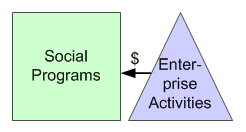 Social programs are distinct from business activities. Nonprofits create external social enterprises to fund their social services and/or operating costs.
The enterprise's activities are "external" from the organization’s operations, but support its social programs through supplementary financing. External social enterprises generally do not benefit from leveraging, cost sharing or program synergies, therefore to serve their purpose, they must be profitable.
External social enterprise may be structured within the parent organization as a profit center, or separately as a nonprofit or for-profit subsidiary. Legal status is often a function of the regulatory environment in which the external social enterprise operates, or a requirement to access capital, (i.e. loans or equity investments). External social enterprises registered as for-profit entities are subject to local tax laws.
The relationship between the business activities and social programs is supportive, providing unrestricted funding to the nonprofit parent organization
External social enterprises are often unrelated to mission; their business activities are not required to advance the organization's mission other than by generating income for the its social programs or overhead.
An external social enterprise generates economic value to support social value creation.
External social enterprises are evident in operational models where:
- economic and social activities are linked via their nonprofit ownership and funding relationship;
- motivation for economic activities is as a funding mechanism for social activities;
- the target population (clients) is a direct beneficiary of income earned from the social enterprise vis-a-vis financing the parent organization, but are infrequently involved in enterprise operations.
The Organizational Support Model often take the form of external social enterprise.
Council of Community Clinics, an example of External Social Enterprise
Council of Community Clinics (CCC) is a San Diego-based nonprofit membership organization comprised of community clinics serving poor, largely Mexican and Central American populations in the region. CCC's mission is to "serve the growing number of uninsured by reducing cost, improving quality of care, and strengthening the capacity of community health centers to improve community health," which it accomplishes through three linked but separate entities: two nonprofits and one for profit subsidiary--an external social enterprise.
CCC's primarily social activities are advocacy, working to change laws to protect at-risk populations and strengthen the health safety net for uninsured and underinsured people. Under the umbrella of CCC is another nonprofit, Community Clinic Health Network (CCHN), which provides technical assistance services to build capacity of community clinics in several areas of healthcare and management. The third structure is a for-profit, Council Connections, a wholly owned for-profit subsidiary of CCC.
Founded in 1996, Council Connections (CC) is a group purchasing business that buys pharmaceuticals, office supplies, medical surgical supplies, and laboratory services in bulk at a volume-based discounted prices, then sells them to community clinics at a slight mark-up, yet substantially cheaper than retail prices. Council Connections business activities are separate from its social programs, and in other than one customer segment, "member" health clinics, there is little overlap with CC's nonprofit parent, Council of Community Clinics. After-tax profit from the group purchasing business provides a significant revenue stream to both nonprofits, CCC and CCHN. The clinics realize substantial savings, which helps to lower their costs, and allocate those savings to their social programs.
Market--In the beginning, the group purchasing business sold its products exclusively to CCC’s members, a relatively small market of a few hundred community clinics in the state of California. As a social enterprise, Council Connections soon realized that it could better serve its customers and increase its profitability by reaching untapped markets. By 2001, of its 691 customers in the State of California, 364 (52.7%) were member community health clinics, and 327 (47.3%) were nonmembers clinics. Entering the nonmember market segment made it possible for CC’s service to benefit more community clinics. The plan is to expand Council Connections' business nationally via the Internet to generate more dollars for clinical services to the uninsured and underinsured.
Financial viability--Income has climbed steadily since Council Connections' first year. In 2001 Council Connections had total sales of $14,370,000, and after tax revenues of $951,566, to reinvest in business growth and social investments in its nonprofit parent. This figure is up 54% from 1997 sales of $6,622,183, and revenue of $531,489 for the same year. Council Connections new online sales business expects revenues to reach $2,500,000 within 5 years.
Social Impact--Council Connections contributed $332,935 in 2001 to CCC and CCHN’s social programs, which translated into subsidies of $207,935 to member clinics, enabling community health clinics to render more discounted and free services to the uninsured and underinsured poor. Seventy-five thousand dollars was used to offset the cost of shared services and $50,000 for technical assistance. In the same year, CC’s member clinics saved a total of $7,650,803 on medical and pharmaceutical supplies and services, allowing clinics to spend those savings on social interests.
Council Connections' primary purpose is to provide funding to its nonprofit parent organization CCC, and nonprofit subsidiary, CCHN. Council Connections secondary purpose is to provide valuable service at reduced costs to its customers, community clinics. Council Connections is an unusual example of a mission-related external social enterprise, it mission states: "support the commitment and mission of community health centers to improve community health by delivering high quality, cost effective patient care through the provision of technical assistance to improve purchasing and inventory systems; reduce costs of products and services; move towards automation, best practices and standardization."
Target Market
Target MarketSocial enterprises, like private businesses, may sell products and services in a variety of markets.
Many economic development income-generating models, such as microfinance and business development programs, are designed so that the paying customer is also the client. In this model the clients are poor people, which limits income potential of the enterprise.
In many civil society programs, such as arts and environmental organizations, the clients are not defined by their economic status and may have considerable purchasing power, thus clients do not limit the revenue potential per se.
In short, social enterprises may serve any type of customer, depending on how financial and social objectives are welded into a business model.
In social enterprises intended to create maximum economic value, then the market sought is that with the greatest ability to pay and where margins will be the highest. A social enterprise where social and economic value generation are intertwined may elect to serve clients, forsaking profit in favor of social impact.
The following chart provides a list of potential social enterprise customers and corresponding examples.
| Market | Description | Examples |
| Target Population | The "client" of the social enterprise and "customer" (user) of the service or product are the same. | Clients of microfinance institutions purchase financial services from the MFI. Small producers who are also clients buy product development and marketing training from a BDS provider. |
| Third Party Payer | The "payer" of the product or service is not the same as the "user," who is the client. Social enterprise third party payers are donors (voucher programs), insurance companies, or government (Medicaid). | Social welfare program pays for health services rendered to indigent people by a community clinic. A local donor provides low income working mothers vouchers to pay for childcare services from a nonprofit childcare organization. |
| General Public | Customers in the open marketplace who buy social enterprise goods and services. In some cases their purchases may be socially motivated. | The public pays admission fees to see a cultural exhibition by an arts organization. Consumers buy used clothing from a thrift store run by a disabilities organization. |
| Businesses and Nonprofits | "Business-to-business" nonprofits or businesses buy products and services from the social enterprise. | A national ice cream manufacturer buys brownies from a bakery staffed by recovering drug addicts, which it uses in some ice cream flavors. Socially conscious businesses purchase renewable energy sources from an environmental organization. |
| Government Contracts | Government buys services and products from the social enterprise. | Area circuit courts purchase a referral service database from a nonprofit for substance abuse organizations. A local government agency purchases janitorial and grounds maintenance services from a disabilities organization. |
Operational Models
Operational ModelsThe following section elaborates possible operational models of social enterprises.
The operational models should not be confused with depictions of organizational or legal structures. Rather, they illustrate configurations used to create social value (measurable impact) and economic value (income), and can be applied equally to institutions, programs, or service delivery.
Operational models are designed in accordance with the social enterprise's financial and social objectives, mission, marketplace dynamics, client needs or capabilities, and legal environment.
Fundamental models can be combined and enhanced to achieve maximum value creation.
Fundamental Models
Fundamental ModelsEntrepreneur Support Model
Entrepreneur Support Model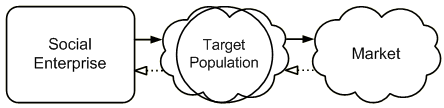 The entrepreneur support model of social enterprise sells business support and financial services to its target population or "clients," self-employed individuals or firms. Social enterprise clients then sell their products and services in the open market.
The entrepreneur support model is usually embedded: the social program is the business, its mission centers on facilitating the financial security of its clients by supporting their entrepreneurial activities. The social enterprise achieves financial self sufficiency through the sales of its services to clients, and uses this income to cover costs associated with delivering entrepreneur support services as well as the business' operating expenses.
Economic development organizations, including microfinance institutions, small and medium enterprise (SME) and business development service (BDS) programs use the entrepreneur support model. Common types of businesses that apply this model are: financial institutions, management consulting, professional services (accounting, legal, and market information), technology and products that support entrepreneurs.
Theoretical example: a manufacturer and distributor of low-cost irrigation pumps sells its pumps and agriculture extension services to low-income rural farmers. The capital asset enables farmers to dramatically increase the productivity and profitability of their land. Income earned by the social enterprise is used to cover operating costs, including the high costs of marketing to rural, small scale farmers, investing in new product R&D, and educational marketing campaigns. (For the real story behind this example, see KickStart).
Pro Mujer, an example of Entrepreneur Support Model
Pro Mujer an international women's development organization, was founded in 1990 to empower women to improve their social and economic status. The organization accomplishes its mission by establishing microfinance institutions that provide small working capital loans ($50-$300) to low income women who invest the capital in productive activities such as retail trade or small-scale production then sell their products in the open marketplace. Due to the perceived risk and high transaction costs to serve Pro Mujer's target population, these poor women have no access to credit and saving services from formal financial institutions, and are consequently easy targets of money lenders' usury practices. Training in business development and management augments Pro Mujer's financial services by helping women to improve their small businesses and increase their incomes, thus economic security for their families. Pro Mujer also provides health education, and links women and their families to health services.
Pro Mujer operates in four countries: Bolivia, Nicaragua, Peru and Mexico. As of June 2002, the organization provided training and credit to over 66,000 clients, almost all of which are low income women, and had total loan portfolio of $5.3 million. The organization's financial model is similar to a bank's, interest is charged on each loan and savings deposits are leveraged for on-lending. The interest spread over significant volume creates a financially sustainable social enterprise model: income covers operating and financial costs, and loan loss (default). Interest rates are set by factoring operational and capital costs, regulations, and competitors' prices. Because its clients are so poor, Pro Mujer's goal is to provide financial services as inexpensively as possible without compromising its viability.
Results of an impact evaluation demonstrated that Pro Mujer's clients are able to double their income after two years in the program. They are also more likely to seek healthcare for themselves, and their children are more likely to go to school. Moreover, clients tend to increase their community leadership and participation and expand their decision-making abilities.
Market Intermediary Model
Market Intermediary Model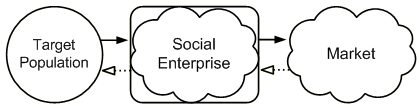 The market intermediary model of social enterprise provides services to its target population or "clients," small producers (individuals, firm or cooperatives), to help them access markets. Social enterprise services add value to client-made products, typically these services include: product development; production and marketing assistance; and credit. The market intermediary either purchases the client-made products outright or takes them on consignment, and then sells the products in high margin markets at a mark-up.
The market intermediary model is usually embedded: the social program is the business, its mission centers on strengthening markets and facilitating clients' financial security by helping them develop and sell their products. The social enterprise achieves financial self-sufficiency through the sale of its client-made products. Income is used to pay the business' operating expenses and to cover program costs of rendering product development, marketing and credit services to clients.
Marketing supply cooperatives, as well as fair trade, agriculture, and handicraft organizations frequently use the market intermediary model of social enterprise. Common types of business that apply this model are: marketing organizations, consumer product firms, or those selling processed foods or agricultural products.
Theoretical example: a craft marketing cooperative creates economic opportunities for rural artisans by purchasing their handmade rugs, baskets, and sculptures and then marketing them overseas. The cooperative buys the products outright at fair prices then sells them at a mark-up to cover operating expenses and business growth. Earned income is also used by the cooperative for social activities tied to business success: helping artisans with product development and quality assurance, and providing working capital loans to clients to purchase raw materials and supplies to produce quality art.
TOPLA, an example of Market Intermediary Model
When Save the Children conducted a study of economic activities of poor women living in rural Haiti it found that many were engaged in food processing to support their families. Rural women purchased citrus fruit and peanuts from local producers and transformed them into peanut butter and jam, staple Haitian breakfast foods, which they sold in their communities. However, these women were unable to maximize profits because the market for their products was saturated (most rural families make their own peanut butter and jam) and purchasing power of their customers was very low. In the same study, Save the Children learned that in cities, such as Port-au-Prince, working moms and urbanites bought peanut butter and jam from supermarkets at prices much higher than those in the rural areas. Rural producers were not capable of selling their products in urban markets because they lacked transportation, marketing knowledge, and retail contacts. Save the Children concluded that it could substantially increase economic opportunities and income for poor rural women through a program aimed at bridging this market gap.
Together with a Haitian nonprofit partner, Save the Children helped establish TOPLA, a social enterprise that markets the women-made food products in urban areas. The social enterprise adds value to the women's existing food transformation activities by improving quality, productivity and enhancing product standardization with basic, semi-industrial processing equipment. TOPLA is able to realize economies of bulk purchase for raw materials, bringing down manufacturing costs and increasing profit margins, which are passed on to its clients. As a market intermediary, TOPLA manages marketing, sales, and distribution functions. In doing so, social enterprise managers found an attractive high margin niche in the "import imitator" market for the TOPLA brand. Import imitators are priced between cheap locally-produced brands and expensive US imports, like Skippy, and appeal to a market segment that is brand and quality conscious yet lacks the means to buy real imports. The products’ stylized packaging and labels add minimal cost and allows the enterprise to earn considerably more on each unit sold than if it had positioned its products in the overcrowded domestically-produced market. Since it was established in 1998, TOPLA has helped hundreds of poor Haitian women earn a livable wage and achieve economic security for their families.
[note: Excerpted from: Alter, Sutia Kim, Managing the Double Bottom Line, Pact 2000]
Pumice Marketing Cooperative, an example of Market Intermediary Model
The Aetas, indigenous people of Luzon, Philippines once lived simply on abundant fish and wildlife, and subsidence farming. The plight of these poor mountain people began when a volcano on Mount Pinatubo erupted in the early 1990s and buried their community and its natural resources under volcanic ash and stone. Threatened with starvation, many Aetas migrated to cities to find jobs. Unskilled, poorly educated, and lacking urban savvy, they were exploited for labor and left to live in urban squalor. Those that stayed stripped the mountain of its few remaining natural resources to survive. Meanwhile, entrepreneurs in Manila discovered the benefits of the acres and acres of stone and rock left behind by the volcano--Pumice, which is used in garment factories to produce “stone washed” denim fashions.
With help from the Asian Institute for technology, Aeta people formed a marketing social enterprise to gather, market and sell the stones to the thousands of garment makers in the Philippines. The marketing cooperative commercializes the informal process of selling pumice to middlemen who pay the Aeta very low prices then realize large profits by selling products to the private sector. As a result of the social enterprise, the Aeta are able earn a livable, rather than a marginal income. The work is appropriate and encourages them to say in their community rather than migrating to cities where their economic prospects are bleak. As well, the alternative livelihood reduces reliance on environmentally destructive activities. This market intermediary model is an example of "small is beautiful"; startup costs were $38,000 in 2003, yielding a return of economic security for hundreds of indigenous people.
[source: Information provided by World Bank Development Marketplace 2003]
Employment Model
Employment Model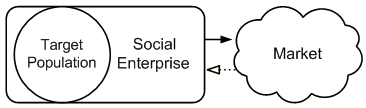 The employment model of social enterprise provides employment opportunities and job training to its target populations or "clients," people with high barriers to employment such as disabled, homeless, at-risk youth, and ex-offenders. The organization operates an enterprise employing its clients, and sells its products or services in the open market. The type of business is predicated on the appropriateness of jobs it creates for its clients, regarding skills development, and consistency with clients' capabilities and limitations, as well as its commercial viability.
The employment model is usually embedded: the social program is the business, its mission centers on creating employment opportunities for clients. Social support services for employees such as "job coaches," soft skill training, physical therapy, mental health counseling, or transitional housing are built into the enterprise model and create an enabling work environment for clients. The social enterprise achieves financial self-sufficiency through the sales of its products and services. Income is used to pay standard operating expenses associated with the business and additional social costs incurred by employing its clients.
The employment model is widely used by disabilities and youth organizations, as well as social service organizations serving low-income women, recovering addicts, formerly homeless people, and welfare to work recipients. Popular types of employment businesses are janitorial and landscape companies, cafes, bookstores, thrift shops, messenger services, bakeries, woodworking, and mechanical repair.
Theoretical example: a wheelchair manufacturing social enterprise is run by clients--victims of landmine accidents--who face discrimination and marginalization in the open market. Workstations are specially fitted to accommodate clients' handicaps. Clients learn marketable skills such as welding, casting, and assembly. The social enterprise sells wheelchairs to hospitals and medical supply companies. Income is used to reinvest in the business, to fund public education campaigns on landmines, and cover the social services costs of physical therapy and counseling for clients.
Mazunte Natural Cosmetics Factory, an example of Employment Model
The Mazunte Natural Cosmetics Factory is situated in the village of its namesake on Mexico's Pacific Coast. Until a few years ago, Mazunte was an obscure village of 1,000, most of whom were employed in the sea turtle trade. When the Mexican government first banned the slaughter of sea turtles, this closed the town's sole employer--Mexico's largest sea turtle slaughterhouse--Mazunte's population was devastated.
Today, the cosmetics factory is known as the "Miracle of Mazunte," because it replaced jobs lost by the slaughterhouse. The small, cooperatively-owned social enterprise produces and distributes environmentally friendly products, and in doing so, provides dozens of manufacturing jobs, sales, and management jobs in the community. The impact, or miracle, proved greater than first expected: the Cosmetics Factory has become the cornerstone of the region's economy. The cute, palm-shaped adobe factory is a tourist magnet, and has sparked the development of a numerous tourist related eco-businesses in the area.
[Source: Information provided by Ashoka's Changemakers ]
Digital Divide Data, an example of Employment Model
Cambodia's long history of war and devastation left a large number of disabled, disenfranchised and displaced people who face barriers to employment. Many Cambodian women have few economic choices other than to enter the sex trade. The poor become trapped in low-income jobs because their families could not afford to send them to school. Rural immigrants, who came to urban areas hoping to find a better life, instead wind up in squatter settlements scratching out a subsistence living picking through garbage heaps. Large numbers of Cambodians physically maimed or disabled in the war are completely marginalized from the workforce as a result of overt discrimination. The situation has created a huge surplus of labor in Cambodia, yet few institutions provide vocational training for this target population to secure relevant jobs.
Technology avails an opportunity for poor and marginalized people to start entry level jobs and gain high value workplace experience and marketable skills while earning a livable wage. Digital Divide Data is a technology-based employment social enterprise that provides vocational training to disadvantaged people in Cambodia. Its clients are landmine victims, abused women, rural immigrants and orphans. Through Digital Divide Data, they receive computer literacy and technology training to qualify for basic and low-skilled jobs in the technology sector. Clients are then placed in data entry jobs within Digital Divide Data whereby they receive paid on-the-job training in a supportive environment.
Digital Divide Data secures contracts for data entry work outsourced by universities and businesses, which provides employment for its clients and generates income for its operating costs, including fair wages and social costs related to education and training. The combination of paid work experience and computer literacy, coupled with education prepares clients for higher-paying skilled work opportunities.
[Source: Information provided by World Bank Development Marketplace 2003]
Fee-for-Service Model
Fee-for-Service Model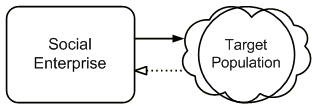 The fee-for-service model of social enterprise commercializes its social services, and then sells them directly to the target populations or "clients," individuals, firms, communities, or to a third party payer.
The fee-for-service model is usually embedded: the social program is the business, its mission centers on rendering social services in the sector it works in, such as health or education. The social enterprise achieves financial self-sufficiency through fees charged for services. This income is used as a cost-recovery mechanism for the organization to pay the expenses to deliver the service and business expenses such as marketing associated with commercializing the social service. Surpluses (net revenue) may be used to subsidize social programs that do not have a built-in cost-recovery component.
Fee-for-service is one of the most commonly used social enterprise models among nonprofits. Membership organizations and trade associations, schools, museums, hospitals, and clinics are typical examples of fee-for-service social enterprises.
Theoretical example: a university charges tuition fees for its educational services, reimbursing costs such as professors' salaries, and building and ground maintenance. However, fees from students are insufficient to fund new facilities or academic research. Therefore, the university supplements tuition income with a second fee-for-service enterprise: commercial scientific and engineering research and development contracts are secured with pharmaceutical and technology companies.
Bookshare.org, an example of Fee-for-Service Model
Fewer than 5% of books are available for people with "print disabilities," blind or learning disabled, posing a significant barrier to literacy. The only way for most people with print disabilities to enjoy books is to scan them into computers with adaptive technology capable of converting the text into speech or Braille formats. Benetech Initiative, a Silicon Valley based-nonprofit organization, that develops adaptive technology saw this gap in the education market as an opportunity to launch its new social enterprise--Bookshare.org.
Bookshare.org is a subscription service providing an extensive online library of digital books for blind and low vision adults, many of whom already use Benetech's computer reading machine technology; and students and adults with learning disabilities. Exempt from US copyright laws, Bookshare.org is allowed to distribute its materials to people with certain disabilities. Bookshare.org's technology enables the tens of thousands of people who scan books to share them, while eliminating duplication of efforts and producing accessible books much faster than other providers at a fraction of the cost. Subscribers download books using Bookshare.org's proprietary software in two formats: digital Braille or talking books. Within a year of its 2002 launch, Bookshare.org already had 12,100 books available to its customers.
Bookshare.org's is a fee-for-service model of social enterprise. Paying customers are also the organization's target population--blind and learning disabled people. A one time fee of $25 is charged to register 1
, and then customers pay an annual subscription fee of $50. Income generated from fees is used to cover cost to render services to its users. In 2002 Bookshare.org's membership was 628; this figure was projected to grow to 2,100 in 2003 and 5,329 in 2004. Bookshare.org is expected to reach breakeven at the end of 2005.
[Source: Information provided by Yale School of Management and Goldman Sachs Foundation: Partnership on Nonprofit Ventures 2003]
- 1Customers must submit proof of a qualifying disability
Low-Income Client as Market Model
Low-Income Client as Market ModelThe Low Income Client as Market model 1
of social enterprise is a variation on the Fee-for-Service model, which recognizes the target population or "clients" a market to sell goods or services. The emphasis of this model is providing poor and low-income clients access to products and services whereby price, distribution, product features, etc. bar access for this market. Examples of products and services may include: healthcare (vaccinations, prescription drugs, eye surgery) and health and hygiene products (iodize salt, soap, eyeglasses, earring aids, sanitary napkins), utility services, (electricity, biomass, and water), etc. for which they pay.
The Low Income Client as Market Model target population has also been described as those living at the "base of the pyramid." This is a socioeconomic designation of the 4 billion people who live primarily in developing countries and whose annual per capita income fall below $1500 purchasing power parity (PPP) 2 ; and earn less than $5 a day 3 . People in this income bracket cannot realize economies of bulk purchase, and ironically may pay up to 30% more for products and services than middle income consumers. 4
The social program is embedded in the activity by providing access to products and services that increase clients' health, education, quality of life, and opportunities. Income is earned from product sales and is used to cover operating costs and marketing and distribution costs. However, due to the low incomes of target population in the "low income client as market model" achieving financial viability can be challenging. The social enterprise must relies on developing creative distribution systems, lowering production and marketing costs, achieving high operating efficiencies, cross-subsidizing creative revenue markets to markets that require subsidy. Health, education, technology, utility frequently use this.
Theoretical example: a nonprofit hospital provides access to high quality healthcare regardless of ability to pay. The hospital focused a few specialized services, which would provide substantial benefits to clients; that could be standardized for high efficiency service delivery; and finally in which they compete on quality in the open market. Pricing is based on ability to pay, whereby clients who can pay full price, yet come for quality care, subsidize those that can't pay or can pay only a portion of full cost. To remove additional access barriers for poor clients, the hospital provides transportation services bringing clients from rural villages to the hospital or conversely, setting up temporary clinics in the villages.
Scojo India, an example of Low-Income Client Model
Scojo Foundation is health social enterprise specialized in eye care. Scojo's work is premised on the statistic that globally 80% of all people above the age of 35 suffer from presbyopia--blurry up close vision. In developing countries where optometry is a privilege of the middle income and wealthy, presbyopia can have a devastating affect on the productive activities of the poor, who typically have little access to eye care. Seamstresses, rug makers, weavers, mechanics, bookkeepers, automobile or bicycle repair people, hairdressers, and others with occupations that require up close vision can loose their livelihoods and their incomes if they suffer from presbyopia. Simple low-cost readymade reading glasses, or simple magnifiers, enable these people to continue to work.
Scojo Foundation founders began their program activities using a traditional nonprofit approach: distributing free readymade reading glasses to the target population in greatest need, the rural poor, but quickly learned that this model was not sustainable. In 2003, they launched Scojo India, an integrated social enterprise that operates in two distinct markets in Andhra Pradesh state: urban centers, targeting working and middle class customers; and rural markets, targeting poor and low income people. Although greater social need exists in India’s rural areas, and subsequently an opportunity to effect deeper social impact than in urban areas, Scojo’s business could not operate exclusively in rural markets without ongoing subsidy.
Characteristics of Scojo's urban market such as high population density, existing retail distribution, coupled with local purchasing power and product price elasticity indicate suitable conditions for a profitable ready-made eyeglass business. Scojo's rural market, on the other hand, has notoriously high costs to sell and distribute eyeglasses in sparsely populated areas to customers (target population) who lack the ability to pay. Therefore, Scojo India created a social enterprise that integrates its business activities. The urban market is the commercial side of the social enterprise's operations while the rural market is the social program side of the social enterprise.
Manufacturing--Products for both markets are manufactured in the same local nonprofit facility, and though style is differentiated in urban markets according to preferences, there is no difference in quality. Scojo transfers modern spectacle frame- and lens-making technology to its Indian partner, building local capacity to enable production of higher quality readymade glasses than are currently available in India. The production facility creates employment opportunities for local people.
Distribution and sales--Integration occurs at the level of the marketing function, but not in the sales activities. Scojo India set a total sales target of 266,760 low-cost readymade reading glasses in the first three years of operation (2003-2006); urban markets represent 75.4% of sales or 201,060 units and rural markets 19.6% or 52,200 units (government sales make up the remaining 5.1%). In urban areas Scojo uses teams of sales agents to sell readymade glasses to non-optical retail stores such as pharmacies, general stores, and bookstores. Sales agents are also dispatched in innovative mobile sales units, vans stocked with glasses, to bring reading glasses to local factories. Scojo India sells reading glasses to hospitals, health and microcredit NGOs, who channel the glasses through their existing network of community-based vision health workers or microentrepreneurs, making it possible for Scojo to penetrate the rural market. Scojo also sells reading glasses to the State Government for re-sale to their employees.
Financial strategy and viability--Scojo India uses a cross-subsidization strategy to achieve social objectives while achieving financial viability. Profits generated from urban sales subsidize price and distribution costs in rural areas where the need for affordable reading glasses is greatest. Glasses are priced at $2.50 for customers in rural areas and $5-$6 for customers in urban areas. Total projected revenue earned in urban markets in the first three years is $460,800 as opposed to $59,805 in rural markets (government represents $10,028). Scojo India projects annual net revenue of $74,532 for business expansion and social program subsidies, and 27.3% ending return on equity in FY 2006.
Social Impact--By year end 2006, more than 266,760 Indians who obtained reading glasses will have improved their productivity and functionality. In three years Scojo India will have created 356 employment opportunities, 327 of which for very low income individuals. As well, micro-entrepreneurs distributing reading glasses in rural areas will earn an average supplemental income of $144 per year, substantial in rural India. The inclusion of moderate income urban customers permits Scojo to expand its target population and reach more people who can benefit from reading glasses, while providing additional funding to serve rural clients sustainably.
Market development and exit strategy--distribution of reading glasses in India is controlled by eye care professionals who lack the financial motivation to sell readymade reading glasses to people from low economic classes. Scojo's aim is to develop the market for readymade reading glasses and replicate the channel shift that took place in the West over a decade ago during which readymade reading glasses became available without prescription in mass-market retail outlets, creating a $1 billion industry. Market development inevitably brings competition. Rather than a threat, this is an opportunity for Scojo to achieve sustainability by transferring its interests to a local social enterprise and to exit the market, and then invest in new markets where the need for readymade reading glasses still exists.
As with other models, the integrated social enterprise model is not straightforward, the degree of integration between the program and business activity in the operational model depends on its purpose--the extent to which the enterprise is used as a funding mechanism or program mechanism. Unlike many integrated social enterprises, Scojo India is a mission-centric example: "to create a sustainable eyeglass manufacturing and distribution operation that makes affordable, quality readymade reading glasses readily available to all low to moderate income individuals in India." Thus, integration of Scojo India's social program and business activities is high. IONA Senior Services is and example of a mission-related social enterprise where less integration occurs between business and social activities.
[Source: Information provided by Yale School of Management and Goldman Sachs Foundation: Partnership on Nonprofit Ventures 2003; Scojo Business Plan Executive Summary]
- 1In most literature, popularized by authors C.K. Prahalad and Stuart Hart, Base of the Pyramid (BoP) Strategies view the BoP as a latent market for multinational corporations and for-profit companies to sell goods and services, and thus the BoP can provide new growth opportunities and innovative selling approaches. For the private sector, the BoP strategy is a subset of corporate strategy, a business first approach which recognizes profit potential of untapped markets and unrealized business opportunities which may also create social or environmental impact as a byproduct. It's important to note that BoP strategy is not social enterprise, although social enterprises may use some of the BoP techniques to serve its low income clients.
- 2Purchasing power parity (PPP) equates the price of a basket of identical goods and services in two countries. PPP provides a standard comparison of real prices between countries.
- 3Prahalad and Hart 2002
- 4Prahalad 2005
Cooperative Model
Cooperative Model The cooperative model of social enterprise provides direct benefit to its target population or "clients," cooperative members, through member services: market information, technical assistance/extension services, collective bargaining power, economies of bulk purchase, access to products and services, access to external markets for member-produced products and services, etc. The cooperative membership is often comprised of small-scale producers in the same product group or a community with common needs--i.e. access to capital or healthcare. Cooperative members are the primary stakeholders in the cooperative, reaping benefits of income, employment, or services, as well as investing in the cooperative with their own resources of time, money, products, labor, etc.
The cooperative model is embedded: the social program is the business. The cooperative's mission centers on providing members services. Financial self sufficiency is achieved through the sales of its products and services to its members (clients) as well as in commercial markets. Cooperatives use revenues to cover costs associated with rendering services to its members and surpluses may be used to subsidize member services.
Cooperatives social enterprises include agricultural marketing cooperatives, which market and sell its members' products, while agricultural supply cooperatives, provide inputs into the agricultural process. Fair trade organizations frequently work with agriculture and commodity producer-owned cooperatives--i.e. coffee, cocoa, wine tea, as well as nonagricultural products--i.e. handicrafts.
Self-Help Groups (SHGs) comprised of low income-women, and popular in South Asia, are frequently organized into cooperatives to support a variety of their members' interests related to commerce, health and education.
Credit Unions are another example of a cooperative tied to economic development and financial service programs, popular across West Africa, Latin America, and Balkans.
In the UK a slight variation on the cooperative, called "mutuals" or "societies" are commonly associated with social enterprise. Unlike a true cooperative, mutual members usually do not contribute to the capital of the social enterprise company by direct investment, instead mutuals are frequently funded by philanthropic sources or the government.
Theoretical example: cooperatively owned and run community savings and credit systems, "Rotating Savings and Credit Associations" (Latin America), Tontins (West Africa), Zadrugas (Balkans) are a form of indigenous credit union long implemented around the world to provide access to financial services. Self-organized community savings and credit systems are capitalized through member investments and savings, which are then mobilized as interest bearing loans also to members. Ownership is communal and equitable with all members owning a stake in the organization. Community savings and credit systems are democratically governed by an elected board of members responsible for financial oversight and loan approval and administration. Community savings and credit systems are self-sufficient through earned interest income from loans.
Equal Exchange, an example of Cooperative Model
Equal Exchange (EE) is a US-based fair trade coffee company legally structured as an employee-owned cooperative and an example of embedded social enterprise. Equal Exchange purchases coffee beans and cocoa directly from small democratically-run farmer cooperatives in developing countries at fair trade prices--a guaranteed minimum price regardless of how low commodities markets fall. Equal Exchange pays a fixed rate of $1.26 and $1.41 per pound for organic certified coffee in contrast to $0.45 and $0.60 per pound that buyers pay on the commodities market1
. The embedded nature of Equal Exchange's social programs is evidenced in its business activities.
Marketing strategy--the company uses educational marketing campaigns to raise awareness of the positive social impact purchasing fair trade coffee has on low income farmers. Equal Exchange's coffee packaging contains information regarding the social benefits of fair-trade purchasing.
Distribution channels--in addition to retail outlets, products are sold through interfaith organizations and nonprofits that educate their constituents about fair trade coffee; then retain a margin on each sale to support their social activities.
Quality products--Equal Exchange assists farmers with sustainable techniques to promote ecological-friendly cultivation of coffee. The results yield higher product quality, environmental conservation, and 85% certified organic fair trade coffee for consumers.
Social Impact--EE works with twenty-five trade partners, farmer cooperatives, in twelve countries, and achieves social impact in two significant ways: supplier credit and fair trade premiums.
- Supplier credit--Most cooperative farmers in developing countries do not have access to bank financing, and those that do pay 25%-35% interest. The more available option is moneylenders, who charge up to 100% of the price of the loan. EE offers pre-harvest credit at interest rates of 8% to 9%, which enables farmers to produce high quality crops without losing margins on the sale of their products. In 2001 EE extended $700,000 in pre-harvest credit to 75% of farmers who requested loans.
- Fair trade premiums have substantial impact on the economic security of farmers and their families, increasing disposable income for food, education, healthcare, housing, etc. EE pays farmers more than twice the going rate on the commodities markets. In 2002, EE paid $1.2 million in fair trade premiums to cooperative farmers. In a protracted commodity price slump, which has occurred in recent years, these premiums literally save thousands of lives by warding off starvation occurring in many coffee growing regions.
Financial strategy and viability--Its for-profit legal status notwithstanding, Equal Exchange's financial motives are viability, not profit; in 2002 the company had $10.4 million in sales, which translated into $1.2 million in above market premiums for cooperative farmers, and funded marketing activities that raised the awareness of tens of thousands of consumers who bought fair trade products. The dollar figures are a monetary representation of Equal Exchange's sustainable mission accomplishment.
Equal Exchange is a mission-centric social enterprise; its business decisions and activities are central to accomplishing its mission: "To build long-term trade partnerships that are economically just and environmentally sound, to foster mutually beneficial relations between farmers and consumers and to demonstrate through our success the viability of worker-owned cooperatives and fair trade."
- 1Statistics from 2002
Market Linkage Model
Market Linkage Model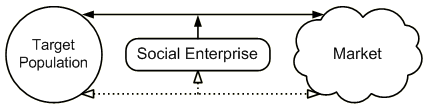 The market linkage model of social enterprise facilitates trade relationships between the target population or “clients,” small producers, local firms and cooperatives, and the external market. The social enterprise functions as a broker connecting buyers to producers and vice versa, and charging fees for this service. Selling market information and research services is a second type of business common in the market linkage model. Unlike the market intermediary model, this type of social enterprise does not sell or market clients' products; rather it connects clients to markets.
The market linkage model can be either embedded or integrated.
If the enterprise is stand-alone; its mission revolving around linking markets, and its social programs support this objective, the model is embedded. In this case, the social program is the business, income generated from enterprise activities is used as a self-financing mechanism for its social programs.
Market linkage social enterprises are also created by commercializing an organization's social services or leveraging its intangible assets, such as trade relationships, and income is used to subsidize its other client services. In this second example, social program and business activities overlap, hence follows the integrated model.
Many trade associations, cooperatives, private sector partnership and business development programs use the market linkage model of social enterprise. Types of social enterprises include, import-export, market research and broker service.
Theoretical example: an agricultural cooperative grows fruits, vegetables and horticulture products, which it sells in domestic, and export markets, saw a business opportunity to leverage its exclusive database of agricultural market data. Until this time only cooperative members had access to the comprehensive information market, however, producers and buyers alike could benefit from this valuable information. Therefore, the cooperative launched a market data and research social enterprise as a means to augment its social programs by extending services to nonmembers. The market linkage social enterprise sells information on local and export market for types of agricultural products, including buyers and producers, prices, export duties, shipping, and chemical and fertilizer regulations, storage, etc. The enterprise has two main services: database search and market information updates that can be purchased individually or by subscription; and market research services such as feasibility analyses and market studies. Most of the social enterprise's clients are farmers, other cooperatives, trade unions, producer groups, small agricultural firms and food processors. The cooperative uses the income generated by its social enterprise to subsidize member services concerning crop improvement, sustainable farming, animal husbandry and agricultural loans.
PhytoTrade, an example of Market Linkage Model
In Southern Africa few economic opportunities exist for the rural poor, many of whom live on annual incomes below $100. An emphasis has been placed on cash-cropping for employment, though 65% of the region is arid and agricultural cash crops are risky for vulnerable populations, ecologically inappropriate and financially unproductive. Employment alternatives residing in the $45 billion global market for natural products have been largely inaccessible for rural African producers. Natural products made from African plant species have a multitude of applications: beverages, cosmetic oils, health care products, herbal teas, jams, nutritional supplements and medicinal products. Because natural products are grown in the wild, their collection and cultivation can easily be managed by rural producers.
PhytoTrade Africa is a non-profit trade association social enterprise that promotes sustainable production and fair trade, contributing to the economic development of southern Africa. PhytoTrade's main aim is to develop business partnerships between rural producers and buyers, major European natural products companies. In doing so, the social enterprise links rural producers in six southern African countries directly to source suppliers, buyers, quality control evaluators, product development specialists; additionally it helps its clients secure export contracts, and provides a clearinghouse for research and development information on African natural products.
In partnership with another nonprofit, Southern African Marula Oil Producers Network (SAMOPN), PhytoTrade Africa embarked on a new venture designed to promote a biodiversity-friendly rural production system. Marula oil is derived from an indigenous plant species that is critical to the maintenance of ecosystem integrity in dryland areas. Commercialization of a range of new marula products is projected to earn between 8,000 and 10,000 rural producers as much as $8-12 million per year, giving rural communities faced with growing economic pressure to convert natural woodlands into arable cropland incentives to invest in sustainable management of dryland ecosystems. SAMOPN helps rural producers with sustainable production and extraction of quality marula oil while PhytoTrade Africa facilitates market linkages and the commercialization process.
In another example, PhytoTrade Africa signed an agreement with Aldivia S.A, a French lipids company. Aldivia is specialized in the sourcing, design, manufacture and commercialization of lipids of plant or vegetable origin for cosmetic and industrial use. PhytoTrade works collaboratively with Aldivia to develop and market a range of biologically active lipid ingredients fabricated by rural producers from a variety of botanical resources indigenous to Southern African. 1
[Source: Information provided by World Bank Development Marketplace 2003]
- 1PhytoTrade Africa website
Service Subsidization Model
Service Subsidization Model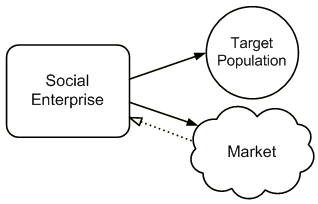 The service subsidization model of social enterprise sells products or services to an external market and uses the income it generates to fund its social programs.
The service subsidization model is usually integrated: business activities and social programs overlap, sharing costs, assets, operations, income and often program attributes. Although the service subsidization model is employed primarily as a financing mechanism--the business mandate is separate from its social mission--the business activities may enlarge or enhance the organization's mission.
Nonprofits that implement service subsidization social enterprises operate many different types of businesses, however, most leverage their tangible assets (building, land, or equipment) or intangible assets (methodology, know-how, relationships, or brand) as the basis of their enterprise activities. Commercialization of core social services leads to enterprise activities that are close in nature to the organization's social programs and may enhance the mission; whereas leveraging physical assets to sell to the public may result in an enterprise that is very different from the organization's social programs. In financial terms the business benefits from leveraging and cost sharing relationships, and provides a stream of unrestricted revenue to "subsidize" or wholly fund one or more social services. Service subsidization is one of the most common types of social enterprises because it can be applied to virtually any nonprofit. The service subsidization model may conceivably grow into an organizational support model if it becomes profitable enough to throw off revenue to the parent organization.
Service subsidization model social enterprises can be any type of business. Those that leverage intangible assets such as expertise, propriety content or methodologies, or exclusive relationships tend toward service businesses that commercialize these assets: consulting, counseling, logistics, employment training or marketing. Those that leverage tangible assets such as buildings, equipment, land, employees, computers, etc. may launch any number of enterprises that utilize infrastructure and capital assets: leasing, property management, product-based retail businesses; copying, transportation or printing services, etc.
Theoretical example: a senior service organization has two social enterprises that generate revenue to subsidize its social programs serving frail indigent seniors. The organization's "eldercare business" commercializes case management services it renders free of charge to its clients. This social enterprise sells "premium eldercare" services, using the organization's expertise in nursing, therapy, and elder wellness in markets where either seniors (or their adult children) have the financial means to pay full fee, or are insured by a company that covers the service. In this case, the enterprise enhances the organization's mission by reaching a larger number of seniors, though not identified as the organization's clients. The organization's second enterprise leverages its 10 passenger van that carries clients on outings, to doctors' appointments, and shopping. The organization leases the vans at night to another nonprofit organization that works to reduce drunk driving accidents by contracting with bars and driving intoxicated customers home after last call. Though the second enterprise provides a social purpose, it is >a href="seum">unrelated to the mission of the senior-services parent organization. The two businesses combined generate 45% of the organization's budget, covering a large portion of its program costs.
ANCA, an example of Service Subsidization Model
Associacao Nacional de Cooperacao Agricola (ANCA) works in areas of Brazil where illiteracy rates are as high as 80% of the population. This education nonprofit provides literacy training and educational services to children, adults, and community activists.
While operating its programs, ANCA recognized a gap in the education market for pertinent leadership and organizing resources for the community activists it serves. In response to this need, ANCA developed training and educational materials for labor movement leaders, and found there was also high demand for these products outside their target population. ANCA saw an opportunity to sell its materials and generate supplemental income for its literacy programs. Thus, ANCA created a social enterprise, Editora Expressao Popular (Popular Expression Press), a publisher and clearinghouse for educational materials for nonprofit leaders and community activists.
Editora Expressao Popular sells periodicals, audiotapes, and publications within Brazil and export markets. The social enterprise enlarges ANCA's mission beyond teaching literacy to also facilitating social change. Editora Expressao Popular is integrated into ANCA as a division of the organization. In 2002 the enterprise sold 7,000 books, up from 4,500 the year before. Income is used to cover start up and operating costs of the press, and to subsidize programs aimed at ANCA's clients overcoming illiteracy.
Organizational Support Model
Organizational Support Model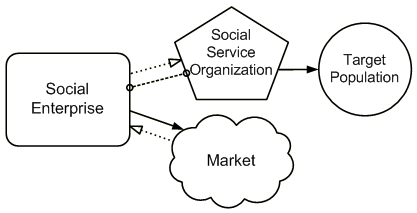 The organizational support model of social enterprise sells products and services to an external market, businesses or general public. In some cases the target population or "client" is the customer.
The organizational support model is usually external: Business activities are separate from social programs, net revenues from the social enterprise provide a funding stream to cover social program costs and operating expenses of the nonprofit parent organization. Although organizational support models may have social attributes, profit not social impact is the perquisite for this type of social enterprise. This model of social enterprise is created as a funding mechanism for the organization and is often structured as a subsidiary business (a nonprofit or for-profit entity) owned by the nonprofit parent. Successful examples of this model cover all or a major portion of the parent organization's budget.
Similar to service subsidization model, the organizational support model may implement virtually any type of business that leverages its assets. This model is commonplace among western nonprofit organizations across sectors.
Theoretical example: an environmental organization created a separate for-profit subsidiary that contracts with the government to conduct environmental monitoring and compliance evaluations of private companies. Profits after tax and business reinvestment are funneled to the nonprofit parent, an environmental education organization. This income represents a major source of unrestricted funding, allocated to the nonprofit's operating expenses as well as environmental advocacy programs for which the organization is unable to obtain donor funding.
Para la Salud, an example of Organizational Support Model
In many rural areas in Guatemala, residents lack access to basic health services, inputs, and medicines. Barriers include: mountainous topography with few roads, poor distribution systems for health inputs, urban flight of medical professionals, and few sources of stable funding for community clinics.
Para la Salud, a national health organization, started a chain of village pharmacies to address this problem. The pharmacy social enterprise was designed as a sustainable distribution model for health inputs in rural areas as well as a means to generate funds to subsidize rural clinics. Para la Salud purchasing is centralized, medicines and supplies are ordered in bulk and shipped to Para la Salud's headquarters in Guatemala City before being sent to rural pharmacies.
The organization has also worked hard to counter the effects of brand marketing by US pharmaceutical companies through educational campaigns that promote lower cost generic drugs. The business model uses streamlined systems, centralized purchasing, inventory management, order fulfillment, and delivery to lower the high transaction costs associated with serving rural areas.
The pharmacies have an average profit margin of 20% to 25%, and profits are used to cover the costs of rural community health clinics. To date, this village pharmacy social enterprise enables a community to self-fund its local clinic without external subsidy in four to five years. Currently, Para la Salud operates 43 village pharmacies serving poor communities in 13 departments in Guatemala.
Combining Models
Combining ModelsSocial enterprises combine operational models to capture opportunities in both commercial markets and social sectors. Combining is a strategy to maximize social impact as well as diversify income by reaching new markets or creating new enterprises. In practice, most experienced social enterprises combine models--few social enterprise operational models exist in their pure form. Operational models are like building blocks that can be arranged to best achieve an organization’s financial and social objectives.
Model combinations occur within a social enterprise (Complex Model) or at the level of the parent organization (Mixed Model).
Social enterprise models are combined to:
- facilitate enterprise or social program growth;
- increase revenues by entering new markets or businesses;
- augment breath or depth of social impact by reaching more people in need or new target populations.
Complex Model
Complex Model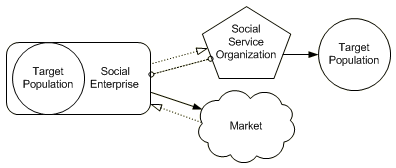 A complex model of social enterprise combines two or more operational models. Complex models are flexible; virtually any number or type of operational models can be combined into one social enterprise.
Models are combined to achieve desired impact and revenue objectives. For example, operational models that fall into integrated or external social enterprise categories may yield greater financial benefit, whereas embedded social enterprises offer higher social return, thus models are combined to achieve the dual objectives of the social enterprise. If appropriate for an organization's target population, the employment model is often combined with one of the other models to add social value--i.e. employment and organizational support model (as illustrated). Operational models are often combined as part of a natural diversification and growth strategy as the social enterprise matures.
Theoretical example: an African horticulture cooperative runs a social enterprise that links local growers to buyers in European markets. The services it provides to small producer clients include: horticulture technical assistance, quality control, contractual relations with flower importers and freight. This social enterprise earns income by charging European companies a commission on each sale, thereby covering the costs of its client services. After some years of operating their market linkage social enterprise, cooperative managers saw a lucrative opportunity to expand their business by entering the horticulture industry as a producer. To avoid competing with their clients, they choose to grow hybrid roses, a market whose infrastructure and costs bar small producers from entering. Hybrid roses are fickle, requiring constant care, which provided the cooperative an opportunity to create employment for a large number of low-income and unskilled people in the community. Profits from the rose business support the parent organization’s hard-to-fund operating costs, as well as funding the startup of a new social enterprise, a horticulture school. This example of a complex model combines: market linkage, organizational support and employment operating models.
Cambiando Vidas, an example of Complex Model
In 1999 a new paved highway opened along Mexico's formally isolated coastal fishing villages in Nayarit State to tourists, and consequently, to large developers. The result was a dramatic shift in the local economy from fishing and agriculture to tourism and infrastructure development. The shift displaced local residents, most of whom are poorly educated peasants and lack the know-how and capital to capture the changing market.
In response, Cambiando Vidas--"Changing Lives," an educational organization, launched a comprehensive, multifaceted rural development program with complementary enterprise and social service components to preserve the local community and provide new livelihoods for its residents.
Cambiando Vidas built a "tool lending library" where residents can borrow hand and power tools and use them as implements in economic activities tied to tourism and construction. The second social component is a vocational training program that teaches construction skills--masonry, electric, plumbing, and carpentry--to unemployed youth and adults in the community. The library supplies tools for the vocational training program.
On the enterprise side, Cambiando Vidas has initiated a B&B project and built (so far) six comfortable tourist rooms above residents' homes. Income from room rental is divided between owners as family income and a revolving loan fund to build more B&B rooms. Apprentices from the vocational training program provide the labor to build the B&Bs and gain work experience in the process.
Next, Cambiando Vidas will create local employment by launching a construction business and bidding directly on small building contracts, where it has identified a viable niche, as well as subcontracting to large developers. Profit from the construction business will be used to fund the secondary education and vocational training program.
Mixed Model
Mixed Model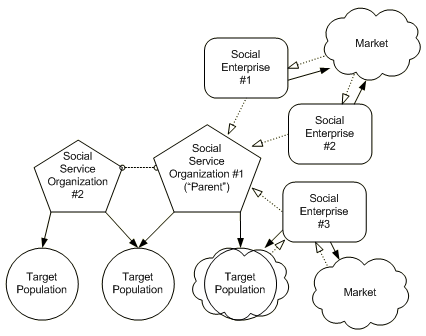 Many nonprofit organizations run multi-unit (mixed) operations, each with different social programs, financial objectives, market opportunities and funding structures. Each unit within the mixed model may be related vis-à-vis target population, social sector, mission, markets, or core competencies. A museum for example, in addition to educational art exhibits, might have both a for-profit catalogue business and highly subsidized research and acquisition operation.1
Nonprofits employing a mixed model combine social and business entities; subsidiaries owned by the parent organization or departments (cost or profit centers) within it to diversify their social services and capitalize on new business and social market opportunities. Like all social enterprises, mixed models come in a variety of forms depending on the organization's age, sector, social and financial objectives and opportunities. The diagram is representative of complexity, not conformity of organizational form.
Mixed models are often a product of an organization’s maturity and social enterprise experience. This model is common among large multi-sector organizations that establish separate departments or subsidiaries for each technical area--i.e. education, health, economic development, etc. and new business ventures. In nonprofits with mature social enterprises, mixed models are the convention, not the exception, a result of expansion and diversification.
Council of Community Clinics, an example of Mixed Model
Council of Community Clinics (CCC) is a San Diego-based nonprofit membership organization comprised of community clinics serving the uninsured and underinsured poor through three linked but separate entities.
The first entity is a nonprofit advocacy organization, Council of Community Clinics (CCC) that lobbies to change legislation to strengthen the health safety net for at-risk populations. The second entity, Community Clinic Health Network (CCHN), is a nonprofit subsidiary of CCC that provides technical assistance services to build capacity of community clinics in several areas of healthcare and management. The third structure is a for-profit, Council Connections is a wholly owned subsidiary of CCC.
Council Connections is a group purchasing business that buys bulk pharmaceuticals, office supplies, medical surgical supplies, and laboratory services at a discounted volume-based prices, then sells them to community clinics at a mark-up, but at substantially cheaper prices than retail.
- 1Dees, Gregory, Enterprising Nonprofits, Harvard Business Review, January-February 1998
Enhancing Models
Enhancing ModelsThis section introduces methods that enhance existing social enterprise operational models.
Franchise Model
Franchise Model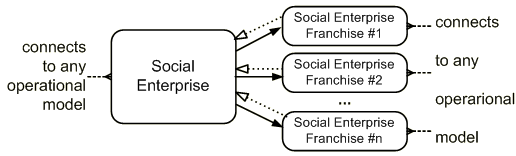 An organization can franchise its "proven social enterprise model" and sell it to other nonprofits to operate as their own business. Franchising enhances nonprofit organizations that have viable, yet non-scaleable social enterprises, through replication. For example, a café that employs disabled people may be profitable only when it employs 12 or fewer disabled people. However, if franchised, the café social enterprise can create employment for hundreds of disabled people. Goodwill Industries’ used clothing and furniture retail stores are a good example of an employment model social enterprise achieving scale through the franchise model.
Hence, the franchise model enhances scalability and social value creation through replication. Purchasers pay franchise fees to receive the social enterprise model, methodology, etc., and ongoing technical support from the franchiser. Buying a franchise enables nonprofit organizations to focus on running operations of a proven enterprise, rather than worrying about what type of business to start, which products to sell, or what markets to enter. Becoming a franchiser creates a new social enterprise for the organization that leverages the organization’s industry and business expertise, and in turn creates new social impact opportunities and another source of earned income.
The franchise itself can be any successful and replicable social enterprise. The social enterprise model may be any of those listed, depending on the type of business and objectives. Ben and Jerry’s Partner Scoop Shop is another good example of a social enterprise enhanced through the franchise model.
Theoretical Example:
An integrated microfinance organization sells its trademarked methodology, which combines health and business education with financial services, to credit unions in developing countries. The US-based parent organization provides consulting and ongoing technical support to franchisees. This approach allows the franchiser to earn money, achieve greater social impact via scale, and keep costs low by leveraging its program methodology and credit unions' infrastructure.
Committee for Democracy in Information Technology (CDI), an example of Franchise Model
The Committee for Democracy in Information Technology (CDI) is a nonprofit organization with a two-fold mission: to promote digital inclusion and create awareness of citizen's rights principles through the use of information technology. CDI works in partnership with schools and community-based associations through a social franchise model providing free computer equipment, software, and educational strategies.
Each school is managed as an autonomous unit and is self-sustainable through contributions made by students, who provide the necessary funds to cover the maintenance costs and the instructors' salaries. Its methodology was developed by CDI in partnership with specialists from the Campinas State University in Brazil, which operates in 19 Brazilian states.
CDI is continuously expanding its national and international network and is presently located in Brazil, Colombia, Chile, Uruguay, Mexico, Guatemala, and Honduras. This educational approach to information technology has also been complemented with extensive job training and an internship program in high-tech related fields, catalyzing a powerful multiplying effect in improving the lives the students and their communities. An interesting example is a group of CDI students from the shantytowns of Rio de Janeiro who first interned with StarMedia Brazil and later went on to secure positions teaching technology and Internet skills to youth with Globo.com and elsewhere.
Private-Nonprofit Partnership Model
Private-Nonprofit Partnership Model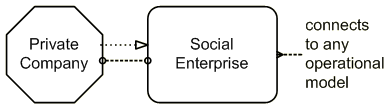 The private-nonprofit partnership model of social enterprise is a mutually beneficial business partnership or joint venture between a for-profit company and a nonprofit organization. The partnership may occur with an existing social enterprise, or may result in the creation of a new entity or a profit center. The social enterprise may or may not be mission-related and leverages the nonprofit organization's assets, such as relationships with their target population, community, brand, or expertise. For the for-profit, the partnership yields one or more of the following benefits: lowers costs (cheaper labor/lower R&D costs); reduces restrictions (no strict regulatory oversight); improves community relations or public image; enables new product development; penetrates new markets; or increases sales. Partnership benefits for the nonprofit are financial return, marketing and brand equity, and in cases where the activity is mission-related, social impact. The market is most often external--the public, but examples exist where the paying customer and the client are one. The private-nonprofit relationship may be structured as a joint venture, a licensing agreement, or formal partnership.
It is worth noting that nonprofits use the term "partnership" loosely to refer to corporate philanthropy or cause-related marketing. The private-nonprofit partnership model is a partnership based on active operational involvement in a social enterprise, not simply a business relationship, which could be a funder, customer or supplier represented in other social enterprise models.
Theoretical example: an environmental organization forms a partnership with a travel and touring company to create a new "Eco Enterprise." The nonprofit organization provides environmental education, consulting services, and access to land conservation trusts and indigenous people under its auspices. The touring company handles marketing, and manages tourists and the touring logistics. The two organizations share the return. The nonprofit uses the proceeds to fund its environmental programs and the company retains or distributes their profit. Benefits for the for-profit are: access to the eco-tourist market, conservation land and local people, and an "eco-friendly" public image. The nonprofit gains: a new vehicle to promote it social programs--the tourist market, a new source of fundraising (many tourists donate to the organization) and social impact vis-à-vis new economic opportunities for indigenous people to sell their environmental products (i.e. handcrafts) or services (boat excursions). Both make money.
Helados Bon, an example of Private-Nonprofit Partnership Model
Helados Bon is large progressive ice cream company based in the Dominican Republic, whose interest in diversifying its ice-cream led to the introduction of a new flavor, macadamia, and the opportunity to help the country's ecology. A partnership was forged between Helados Bon and an environmental nonprofit, Plan Sierra. The business idea leveraged each of the partners' knowledge and assets, marrying Helados Bon's ice cream industry expertise with Plan Sierra's conservation efforts. The social enterprise that emerged helps local farmers grow macadamia trees and reforest farmland through the sale of delicious ice cream.
Macadamia trees, which are capable of growing to a height of over 500 meters on infertile land, are ideal for reforestation and conservation of natural resources. In the partnership, Plan Sierra manages and coordinates local farmers growing macadamia nuts which are used to make the new ice cream flavor; Helados operates the production and sale of the macadamia ice cream. The social enterprise earns one peso for each double macadamia ice cream sold to fund macadamia conservation efforts and local farmers gain a steady customer for their macadamia nuts. Helados Bon also disseminates information about conservation and the importance of growing macadamia to its customers. Plan Sierra uses the revenue generated by the social enterprise to promote and develop its macadamia program.
The partnership is a win-win proposition for all of those involved: Helados Bon increased its sales; Plan Sierra achieved the reforestation of more than 140,000 hectares with macadamia trees; and farmers have benefited with higher paying jobs and marketable crops.
Social Enterprise Structures
Social Enterprise StructuresOrganizational Structure
Organizational StructureA social enterprise may be structured as a department, program or profit center within a nonprofit and lack legal definition from its parent organization. It may also be a subsidiary of its nonprofit parent, registered either as a for-profit or nonprofit. Many organizations use a mix of different structures simultaneously.
The following diagrams illustrate the social enterprise structure vis-à-vis its relationship to the parent organization.
Structured Internally
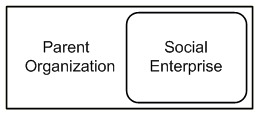 Social enterprise is structured as a department or profit center within the parent organization. The social enterprise may (or may not) physically share space with the parent. From a legal, financial, management, and governance perspective the enterprise is internal to its nonprofit parent. Systems, back office, staff, and leadership are integrated.
Any of the operational models can be structured internally within the parent organization; however, embedded and integrated social enterprises are the most common forms using this structure.
Structured as a Separate Entity
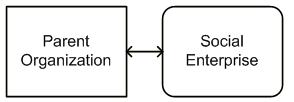 Social enterprise is structured as a separate legal entity, either a for-profit or a nonprofit. In this case, the social enterprise may or may not physically share space with the parent. From a legal, financial, management, and governance perspective the enterprise is external to its nonprofit parent. If staff, overhead, or back office is shared, this is done so on a formal (contractual) basis as a business relationship. .
Any of the operational models can be structured as a separate entity from the parent organization; however, integrated and external social enterprises are the most common forms using this structure.
Structured as the Same Entity
 Social enterprise is the same entity as the parent organization, meaning functionally that there is NO parent or host organization, rather the social enterprise is the only activity of the organization. There is no delineation between program, administrative and infrastructure aspects indicating the existence of two or more types of activities. This type of social enterprise may evolve into one of the other structures by adding new enterprises or social programs.
Embedded social enterprises are the most common form using this structure.
Legal Structure
Legal StructureA social enterprise may be incorporated either as a for-profit or a nonprofit.1 It is however important to recognize that social enterprises are not defined by their legal status: legal status may be arbitrary. A social enterprise’s structure or model is not a definitive determinate of its legal status.
The decision to incorporate the social enterprise separately from the parent, and then to do so as a for-profit or nonprofit is driven by one or more of the following factors:
Legal Environment
The law in many countries does not make provisions or recognize the social enterprise (income-generating nonprofit) as legitimate or legal. Therefore, nonprofit organizations risk losing their nonprofit status and associated privileges by launching a social enterprise or income-generating activity. Some countries have made special provisions in the law and tax codes for social enterprises.
Legal issues are complex and vary widely. The environment is more enabling in some countries than in others; however, there is still work to be done around the world on this issue.
Generally speaking governments regulate social enterprise according to:
- nature of business activities--related or unrelated to organization's mission;
- use or destination of earned income--to mission activities or other purposes;
- source of income--general public, clients, 3rd party payers (insurance, donors), government;
- the amount of income earned through social enterprise--limits placed on either monetary amount of percentage of budget; or
- a combination of these.
In any case, the legal situation must be analyzed on a country-by-country and case-by-case basis.
Regulatory Environment in Emerging Market Countries2
While the legal environment varies from country to country, a general lack of clarity in the law about the legality and tax treatment of NGOs engaged in economic and commercial activities in emerging market countries results in a variety of practical and ethical challenges for many NGOs.3
Many social enterprises operate in "legal grey areas," fearing that their commercial activities will jeopardize their NGO status. Attempts to remain "off the radar screen" of local authorities forces social enterprises to remain small and thus unable to maximize their profit potential or achieve scale. In some instances, local authorities or "tax police" take advantage of the ambiguous laws and extort social enterprises, requiring them to pay bribes or exorbitant taxes that can threaten the survival of both the enterprise and the NGO. In other cases, governments have eagerly looked to social enterprises as a new mechanism for building the tax base, and charged high taxes on earned income, crippling social enterprise performance and preventing them from achieving their purpose of funding social activities. Where the laws are clearer, reporting requirements can be burdensome, penalties harsh, or tax incentives nonexistent. Furthermore, the lack of clarity in the law presents an ethical dilemma for NGOs as they struggle to promote and preserve a reputation of transparency and accountability to their constituents, donors, and public-at-large, while also trying to identify the most favorable tax treatment for their social enterprise.
Although the microfinance field has made inroads into creating an enabling environment for NGO financial service businesses and raising awareness about NGO income generated as a means to achieve sustainability, the legal environment for social enterprise development can still be strengthened. Advocacy efforts have the opportunity to dovetail with the work of microfinance, broadening governments' understanding of social enterprises not as a mechanism to build the tax base, but rather as an instrument to replace government funds that draw from taxes. An unambiguous and favorable legal environment, such as tax incentives to social enterprises, would not only foster growth in this field, but would also serve to increase integrity and clarify ethical questions and public misperceptions regarding NGO commercial activities.
Access to Capital
Social enterprises are capitalized through a variety of different instruments: grants, loans, charitable contributions, program-related investments (soft loans, etc.), or a combination thereof. The type of funding a social enterprise is able to obtain depends on its maturity, reputation, availability of funding (nonprofit capital market), and legal structure. On the latter point, an organization may choose a legal structure that is consistent with the funding it seeks. For-profits are often barred from receiving philanthropic funds and soft loans, whereas nonprofits have difficulty obtaining commercial funds--borrowed capital. In this case, legal status may be guided by the requirements for the most suitable type of funding.
Capitalization
Undercapitalization is a problem as common in private business as it is for social enterprises, particularly for capital intensive enterprises such as manufacturing. For-profits have the ability to raise equity investments that, depending on the local laws, are not an option for nonprofits, whose assets are considered publicly owned. Some social enterprises opt to incorporate as a for-profit and many mature nonprofits convert their legal status in order to capitalize the business with private funds in exchange for equity. In the early stage, social enterprise incubation usually occurs within a nonprofit parent, which also serves to capitalize the nascent enterprise.
Leadership Decision
Frequently the board or executive director will opt to incorporate the social enterprise as a separate legal entity simply out of preference. Integrating business practices and income-generation into a nonprofit organization rocks institutional culture and tests capacity, potentially threatening core social service programs of the parent organization and causing internal strife or mission drift. Also, when the business is unrelated to the organization's mission, it can be difficult to gain stakeholder and staff support. In these instances, leadership may prefer to separate the entities both physically and legally.
- 1In the US this is a 501(c)(3) and in most developing countries a nongovernmental organization (NGO)
- 2For more information pertaining to social enterprise legal issues in emerging markets see: Etchart, Nicole and Lee Davis, Legal Series: Chile and Columbia, 2002; and Profits For Nonprofits, NESsT, 1999, chapter 3 Legal Issues as well as: International Center for Not-For-Profit Law (ICNL)
- 3Etchart, Nicole and Lee Davis, Unique and Universal: Lessons from the Emerging Field of Social Enterprise in the Emerging Market Countries, NESsT, 2003.
Ownership Structures
Ownership StructuresThree different types of social enterprise ownership structures exist: private, public and collective. Ownership can be either a driver for a social enterprise's legal structure or a determinate of it. In most counties nonprofits are considered "public good" or property of the public, thus calling into question the legal ownership of their assets, goodwill, brand, etc.
Public ownership may be practiced in the form of decision-making and participation as long as the organization is a going concern. Similar to traditional nonprofits, a public ownership structure indicates that governing board of directors directs strategy and financial oversight. Legally, nonprofit ownership becomes an issue if the owner(s) wants to sell the social enterprise, or close it and liquidates the assets.
Private ownershipof a social enterprise offers benefits of equity financing, unambiguous asset ownership and valuation, and the freedom to sell the enterprise. Conflict can arise between fundamental motives of profit-making and mission. For-profits must minimally breakeven and often have tax liabilities, limiting the type and purpose of the enterprise to more productive and financially driven models than those that may serve a social need, yet run at a deficit.
Public
Nonprofit Organizations -- the classic nonprofit organization is considered "public good," or property of the public. Nonprofits may own a for-profit or nonprofit social enterprise subsidiary. In the case of the for-profit, the nonprofit may sell the subsidiary or its assets, or raise equity for new investments; whereas the nonprofit subsidiary may raise charitable funds, but not equity and is subject to donor requirements and nonprofit law regarding ownership of assets and use of revenue. The nonprofit parent of the nonprofit subsidiary may acquire the assets of the social enterprise if the business fails or is closed.
Public Shareholders -- a consortium of nonprofit stakeholders that "hold shares" in a social enterprise (nonprofit or for-profit). Often the shareholders are comprised of parent organizations, partners and donors that have an existing program or financial stake in the social enterprise. Legal issues are similar for other public entities under this ownership structure. The public shareholder model is frequently used as an exit strategy when a parent organization seeks to spin off a social enterprise into an autonomous legal entity, yet wants to maintain some decision making power and preserve the mission during the transitional period to independence.
Cooperative
Nonprofit cooperatives are a common form of social enterprise particularly in developing countries. Driven by their social mission, most nonprofit cooperatives have a legal incorporation similar to other types of nonprofits, and are thus entitled to similar benefits as well as limited by similar restrictions as nonprofits. In practice, owners are "members" of the nonprofit cooperative and though they may have programmatic and business decision-making authority and realize certain advantages, they do not actually own the brand, infrastructure, assets, methodology, programs, revenue, etc. and do not enjoy private property ownership rights. The nonprofit cooperative requires oversight by a board of directors. The target population is the nonprofit cooperative’s membership; members realize social benefits, but do not receive income distributed from business activities.
For-profit cooperatives -- "cooperatively" or group owned social enterprise registered as a for-profit is age-old structure in both developing and industrialized countries. These cooperatives are profit-driven structures whose social contribution is aimed at improving economic conditions of a particular group, such as farmer or artisan cooperative. Often for-profit cooperatives (such as Equal Exchange, our example of Embedded Social Enterprise) are worker owned. Owners may also be called members and exercise legal rights and decision-making authority tied to property ownership: to sell, dissolve, liquidate the business and its assets, or expand the business and use revenue as they see fit. Owners may elect distribute profits to themselves or retain earning to reinvest in their business.
Private
Sole proprietorship -- in several emerging-market countries social enterprises are owned by a single individual to bypass laws restricting nonprofit commercial activity. In this situation the social enterprise owner is often the parent organization's executive director or a member of its board of directors. This structure introduces a risk of the business being cannibalized by an unscrupulous owner. Unfortunately in many countries, until the legal environment becomes more enabling, this is the only ownership option available. These entities though created to support a nonprofit are subject to local taxes and laws governing private businesses.
Private Shareholders -- in developing countries, the financial service industry is the leading example of shareholders and investor ownership of social enterprises (microfinance institutions, community or rural banks, credit unions, etc). Microfinance organizations that successfully commercialize their services and transform into for-profit financial institutions may sell shares to individuals, the government, other nonprofit organizations and donors to raise equity. Public sector owners are not required to be stakeholders in the parent organization or social enterprise other than as a social investor. Ownership shares may also be distributed to the target population as part of the social model. For example, when the Grameen Bank project transformed into an independent bank, it distributed 90% of its ownership to the poor rural borrowers its serves, while the remaining 10% was purchased by the government.
Benevolent Owners -- private ownership of social enterprises generally falls under the rubric of socially responsible business. In industrialized countries there are a growing number of small businesses created for the purpose of contributing to a social cause and generating revenue for their owners. In the United States, practitioners have formed their own industry organization: Social Venture Network. These businesses operate in accordance to standard laws for small business. For more information, see also the Business for Social Responsibility web site.