
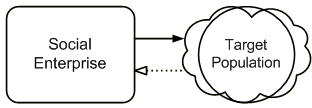
 The fee-for-service model of social enterprise commercializes its social services, and then sells them directly to the target populations or "clients," individuals, firms, communities, or to a third party payer.
The fee-for-service model is usually embedded: the social program is the business, its mission centers on rendering social services in the sector it works in, such as health or education. The social enterprise achieves financial self-sufficiency through fees charged for services. This income is used as a cost-recovery mechanism for the organization to pay the expenses to deliver the service and business expenses such as marketing associated with commercializing the social service. Surpluses (net revenue) may be used to subsidize social programs that do not have a built-in cost-recovery component.
Fee-for-service is one of the most commonly used social enterprise models among nonprofits. Membership organizations and trade associations, schools, museums, hospitals, and clinics are typical examples of fee-for-service social enterprises.
Theoretical example: a university charges tuition fees for its educational services, reimbursing costs such as professors' salaries, and building and ground maintenance. However, fees from students are insufficient to fund new facilities or academic research. Therefore, the university supplements tuition income with a second fee-for-service enterprise: commercial scientific and engineering research and development contracts are secured with pharmaceutical and technology companies.
Bookshare.org, an example of Fee-for-Service Model
Fewer than 5% of books are available for people with "print disabilities," blind or learning disabled, posing a significant barrier to literacy. The only way for most people with print disabilities to enjoy books is to scan them into computers with adaptive technology capable of converting the text into speech or Braille formats. Benetech Initiative, a Silicon Valley based-nonprofit organization, that develops adaptive technology saw this gap in the education market as an opportunity to launch its new social enterprise--Bookshare.org.
Bookshare.org is a subscription service providing an extensive online library of digital books for blind and low vision adults, many of whom already use Benetech's computer reading machine technology; and students and adults with learning disabilities. Exempt from US copyright laws, Bookshare.org is allowed to distribute its materials to people with certain disabilities. Bookshare.org's technology enables the tens of thousands of people who scan books to share them, while eliminating duplication of efforts and producing accessible books much faster than other providers at a fraction of the cost. Subscribers download books using Bookshare.org's proprietary software in two formats: digital Braille or talking books. Within a year of its 2002 launch, Bookshare.org already had 12,100 books available to its customers.
Bookshare.org's is a fee-for-service model of social enterprise. Paying customers are also the organization's target population--blind and learning disabled people. A one time fee of $25 is charged to register 1
, and then customers pay an annual subscription fee of $50. Income generated from fees is used to cover cost to render services to its users. In 2002 Bookshare.org's membership was 628; this figure was projected to grow to 2,100 in 2003 and 5,329 in 2004. Bookshare.org is expected to reach breakeven at the end of 2005.
[Source: Information provided by Yale School of Management and Goldman Sachs Foundation: Partnership on Nonprofit Ventures 2003]
- 1Customers must submit proof of a qualifying disability