Enhancing Models
Enhancing ModelsThis section introduces methods that enhance existing social enterprise operational models.
Franchise Model
Franchise Model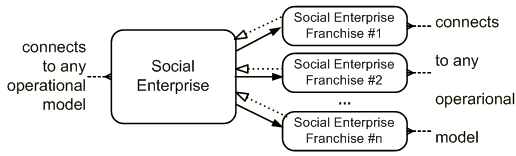 An organization can franchise its "proven social enterprise model" and sell it to other nonprofits to operate as their own business. Franchising enhances nonprofit organizations that have viable, yet non-scaleable social enterprises, through replication. For example, a café that employs disabled people may be profitable only when it employs 12 or fewer disabled people. However, if franchised, the café social enterprise can create employment for hundreds of disabled people. Goodwill Industries’ used clothing and furniture retail stores are a good example of an employment model social enterprise achieving scale through the franchise model.
Hence, the franchise model enhances scalability and social value creation through replication. Purchasers pay franchise fees to receive the social enterprise model, methodology, etc., and ongoing technical support from the franchiser. Buying a franchise enables nonprofit organizations to focus on running operations of a proven enterprise, rather than worrying about what type of business to start, which products to sell, or what markets to enter. Becoming a franchiser creates a new social enterprise for the organization that leverages the organization’s industry and business expertise, and in turn creates new social impact opportunities and another source of earned income.
The franchise itself can be any successful and replicable social enterprise. The social enterprise model may be any of those listed, depending on the type of business and objectives. Ben and Jerry’s Partner Scoop Shop is another good example of a social enterprise enhanced through the franchise model.
Theoretical Example:
An integrated microfinance organization sells its trademarked methodology, which combines health and business education with financial services, to credit unions in developing countries. The US-based parent organization provides consulting and ongoing technical support to franchisees. This approach allows the franchiser to earn money, achieve greater social impact via scale, and keep costs low by leveraging its program methodology and credit unions' infrastructure.
Committee for Democracy in Information Technology (CDI), an example of Franchise Model
The Committee for Democracy in Information Technology (CDI) is a nonprofit organization with a two-fold mission: to promote digital inclusion and create awareness of citizen's rights principles through the use of information technology. CDI works in partnership with schools and community-based associations through a social franchise model providing free computer equipment, software, and educational strategies.
Each school is managed as an autonomous unit and is self-sustainable through contributions made by students, who provide the necessary funds to cover the maintenance costs and the instructors' salaries. Its methodology was developed by CDI in partnership with specialists from the Campinas State University in Brazil, which operates in 19 Brazilian states.
CDI is continuously expanding its national and international network and is presently located in Brazil, Colombia, Chile, Uruguay, Mexico, Guatemala, and Honduras. This educational approach to information technology has also been complemented with extensive job training and an internship program in high-tech related fields, catalyzing a powerful multiplying effect in improving the lives the students and their communities. An interesting example is a group of CDI students from the shantytowns of Rio de Janeiro who first interned with StarMedia Brazil and later went on to secure positions teaching technology and Internet skills to youth with Globo.com and elsewhere.
Private-Nonprofit Partnership Model
Private-Nonprofit Partnership Model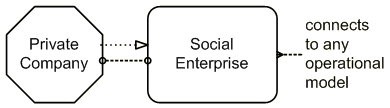 The private-nonprofit partnership model of social enterprise is a mutually beneficial business partnership or joint venture between a for-profit company and a nonprofit organization. The partnership may occur with an existing social enterprise, or may result in the creation of a new entity or a profit center. The social enterprise may or may not be mission-related and leverages the nonprofit organization's assets, such as relationships with their target population, community, brand, or expertise. For the for-profit, the partnership yields one or more of the following benefits: lowers costs (cheaper labor/lower R&D costs); reduces restrictions (no strict regulatory oversight); improves community relations or public image; enables new product development; penetrates new markets; or increases sales. Partnership benefits for the nonprofit are financial return, marketing and brand equity, and in cases where the activity is mission-related, social impact. The market is most often external--the public, but examples exist where the paying customer and the client are one. The private-nonprofit relationship may be structured as a joint venture, a licensing agreement, or formal partnership.
It is worth noting that nonprofits use the term "partnership" loosely to refer to corporate philanthropy or cause-related marketing. The private-nonprofit partnership model is a partnership based on active operational involvement in a social enterprise, not simply a business relationship, which could be a funder, customer or supplier represented in other social enterprise models.
Theoretical example: an environmental organization forms a partnership with a travel and touring company to create a new "Eco Enterprise." The nonprofit organization provides environmental education, consulting services, and access to land conservation trusts and indigenous people under its auspices. The touring company handles marketing, and manages tourists and the touring logistics. The two organizations share the return. The nonprofit uses the proceeds to fund its environmental programs and the company retains or distributes their profit. Benefits for the for-profit are: access to the eco-tourist market, conservation land and local people, and an "eco-friendly" public image. The nonprofit gains: a new vehicle to promote it social programs--the tourist market, a new source of fundraising (many tourists donate to the organization) and social impact vis-à-vis new economic opportunities for indigenous people to sell their environmental products (i.e. handcrafts) or services (boat excursions). Both make money.
Helados Bon, an example of Private-Nonprofit Partnership Model
Helados Bon is large progressive ice cream company based in the Dominican Republic, whose interest in diversifying its ice-cream led to the introduction of a new flavor, macadamia, and the opportunity to help the country's ecology. A partnership was forged between Helados Bon and an environmental nonprofit, Plan Sierra. The business idea leveraged each of the partners' knowledge and assets, marrying Helados Bon's ice cream industry expertise with Plan Sierra's conservation efforts. The social enterprise that emerged helps local farmers grow macadamia trees and reforest farmland through the sale of delicious ice cream.
Macadamia trees, which are capable of growing to a height of over 500 meters on infertile land, are ideal for reforestation and conservation of natural resources. In the partnership, Plan Sierra manages and coordinates local farmers growing macadamia nuts which are used to make the new ice cream flavor; Helados operates the production and sale of the macadamia ice cream. The social enterprise earns one peso for each double macadamia ice cream sold to fund macadamia conservation efforts and local farmers gain a steady customer for their macadamia nuts. Helados Bon also disseminates information about conservation and the importance of growing macadamia to its customers. Plan Sierra uses the revenue generated by the social enterprise to promote and develop its macadamia program.
The partnership is a win-win proposition for all of those involved: Helados Bon increased its sales; Plan Sierra achieved the reforestation of more than 140,000 hectares with macadamia trees; and farmers have benefited with higher paying jobs and marketable crops.